
A funny thing happened in ERCOT in June and July. While the grid (mercifully) didn’t experience any major outages, wind generation actually fell year-over-year from the prior-year periods – despite an increase in wind generation capacity. There remains a great deal of uncertainty surrounding climate change and wind cyclicality. In this article we explore ERCOT’s summer generation profile and the mysterious downturn in ERCOT wind generation.
Lukewarm ERCOT Summer
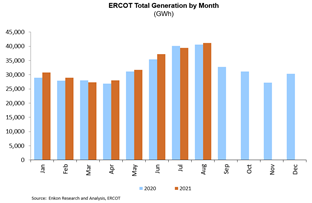
ERCOT 2021 YTD generation is only up 2.1% year-over-year. While ERCOT’s February outage suppressed y-o-y electricity consumption to a degree, we are frankly quite surprised that summer demand was not more robust: vaccinations have sharply lifted mobility and economic growth, Texas population growth is very high, and most grid-connected LNG/petrochemical facilities (including Freeport LNG) are running at full capacity, unlike last year. We strongly suspect temperate weather is dampening electricity usage: both Dallas and Houston experienced relatively low July temperatures, according to the National Weather Service; NOAA also shows that Texas temperatures fell. July’s slight decline in ERCOT total generation is almost certainly due to fewer cooling degree days.
Wind Generation… is down?
This summer also witnessed another surprising event in ERCOT: declining y-o-y wind generation in June and July. As seen in the graph below, June and July 2021 wind generation actually fell sharply from the same prior-year periods.
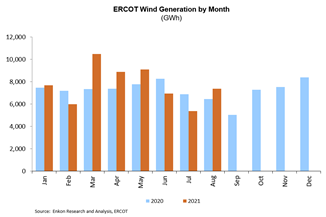
While Texas wind capacity factors tend to decline in the summer, the sharp decline in y-o-y wind generation is notable considering that installed wind capacity rose by about 2.3 GW to ~27.3 GW over the same period, according to ERCOT. What explains the sharp apparent decline in wind capacity factors?
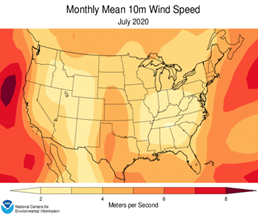
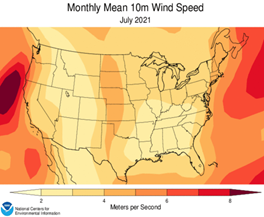
We believe that slower Texas wind speeds drove ERCOT wind generation sharply lower. As you can see below, the wind-producing regions of West and North Texas experienced lower mean wind speeds and less favorable wind generation conditions.
What does ERCOT’s summer say about its future?
This summer appears to be an exception, not the norm. In the future, we expect to see higher temperatures amid climate change, more wind generation from greater capacity (and more efficient capacity utilization from newer turbines), and higher wind speeds.
Still, there is some limited evidence that mean wind speeds fell across the world: RWE also reported “much lower” wind volumes in Europe in the first half of 2021. Was 2021 a cyclical downtick or the beginning of a secular, global trend? While there is no expert consensus on these issues, wind fundamentals will continue to have massive implications for ERCOT and the grid.