Clean ammonia is fast emerging as the front runner in global decarbonization efforts in various hard-to-abate sectors from power generation and maritime shipping. Domestically, clean ammonia is shaping to be a vital component of a pragmatic U.S. energy transition future. Recent advancements in technology, favorable regulatory policies, sizable federal subsidies and corporate sustainability initiatives have paved the way for the development of clean and low-carbon ammonia projects in the U.S. The importance of clean ammonia “as a carrier” for the uptake of low-cost or clean hydrogen cannot be overstated with a significant export potential due to foreign governments’ decarbonization initiatives and corporate clean power sourcing.
Why Ammonia? What are Key Regulatory Incentives?
Ammonia, which does not emit CO2 when burned, has chemical and physical properties ideally suited for increasing the role of hydrogen in the energy ecosystem of the future. Ammonia does not require cooling at extreme temperatures, and has a higher energy density than liquid hydrogen, making it more efficient to store and transport using current shipping fleet. Furthermore, producing ammonia with renewable energy results in zero or minimal greenhouse gas emissions for low-carbon ammonia where CO2 produced during ammonia production is captured and sequestered.
There is significant government funding, tax credits and other incentives under the Inflation Reduction Act (IRA) to position the U.S. to become a low-carbon hydrogen and ammonia exporter from the U.S. Gulf Coast.
- The DOE has enabled access to low-cost debt capital through loan guarantees focusing on renewable electricity and clean hydrogen production.
- Department of Energy (DOE) has allocated grants worth ~$8 Billion to support the development of seven hydrogen hubs. These hubs serve as focal points for hydrogen-related research, development, and deployment activities, positioning hydrogen as a key player in the transition to cleaner energy sources.
- Additionally, sizable IRA tax credits are available for production of renewable power/hydrogen from qualified resources including wind, solar, geothermal, closed, and open-loop biomass, and municipal solid waste. Also, to simplify tax equity, Investment Tax Credits “ITC” and Production Tax Credits “PTC” credits can now be transferred or are eligible for direct refund from the IRS.
The IRA (45Q/45V) tax credits has the potential to make the U.S. produced clean ammonia among the most competitive in the world (we will cover clean ammonia export economics in a follow-up blog).
U.S. Clean Ammonia Project Landscape
Production economics for clean and low-carbon ammonia in the U.S. are promising with an abundance of cheap natural gas, suitable geology for CCS, pipeline infrastructure, export infrastructure, abundance of renewable resource, and policy support for clean ammonia development. Consequently, a plethora of greenfield and brownfield low-carbon ammonia projects in the U.S. are under various stages of development. As of April 2024, ~62 MTPA of clean (green) and low-carbon (blue) ammonia production facilities are in the development funnel as shown below – some more advanced than others.
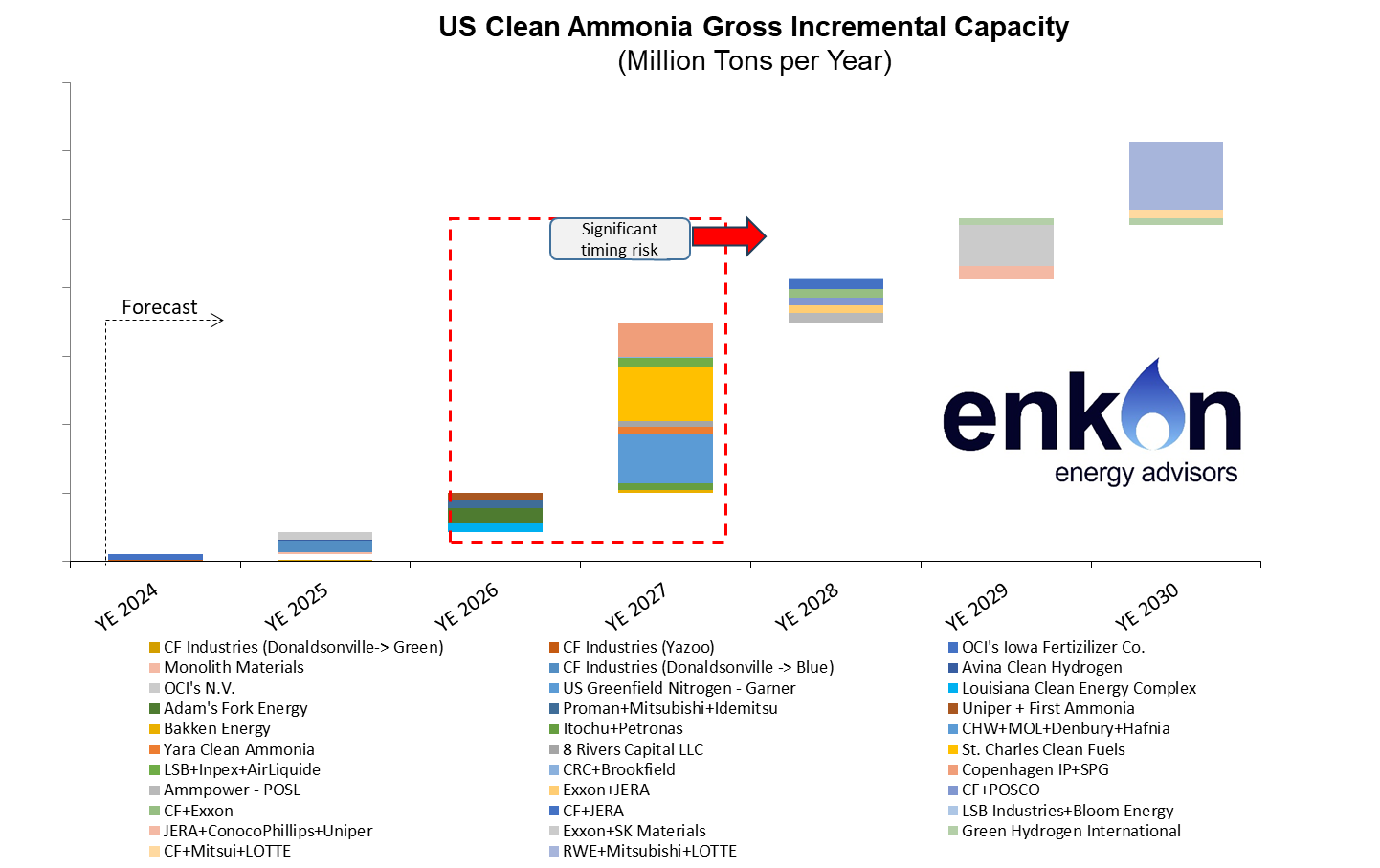
Several upcoming clean ammonia projects in the United States are set to enter the market in the coming years, targeting the emerging export demand. Several proposed projects are currently in the Pre-FEED or FEED study phase with Final Investment Decision (“FID”) timelines during 2025-27. The FID timelines indicate a high probability that the advertised start-up timings (as indicated in the graph above) are expected to slip by at least a year or more.
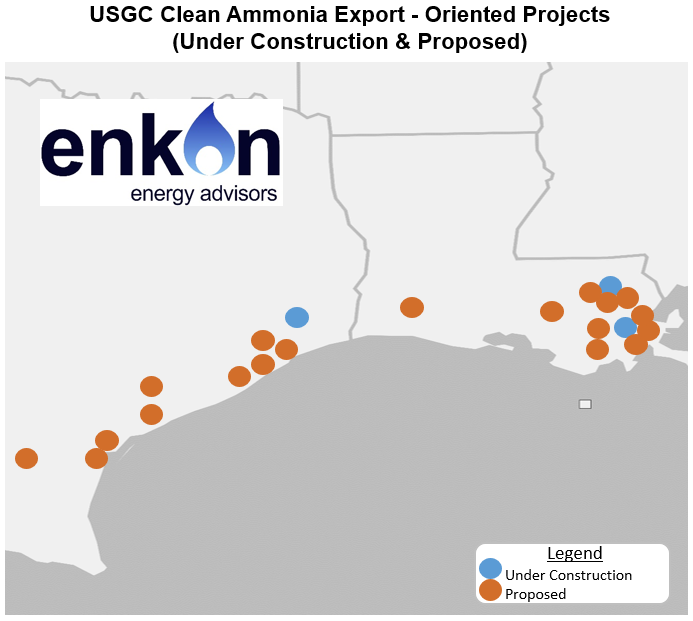
The Map below outlines “export-oriented” clean ammonia projects that currently add up to 56 MTPA (or ~90% of proposed clean ammonia capacity). While all projects will not reach commercial fruition, significant export demand-pull and favorable incentives will enable U.S. to be a major exporter of clean ammonia by 2030.
Outlook for Clean Ammonia Growth in Export Markets
Key export customers for U.S. clean ammonia include agricultural sector in Europe, where strict environmental regulations and sustainability targets are driving the demand for eco-friendly fertilizers. Additionally, countries like Japan and South Korea are exploring clean ammonia as a potential fuel for power generation, creating new export opportunities for U.S. clean ammonia producers.
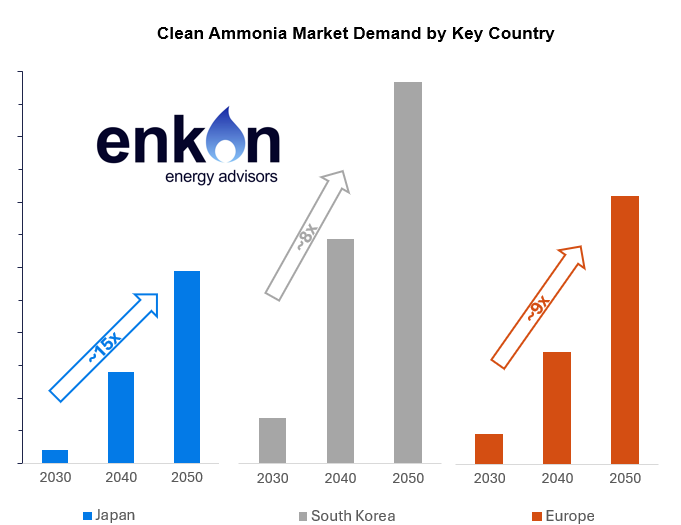
With EU policies focused more on the demand-side rather than the supply-side, uptake of ammonia will be a more seamless and appealing market for U.S. clean export. There is an abundance of funding mechanisms to advance ammonia uptake and support EU entities to import ammonia at lower prices. EU ETS carbon tax allows companies to trade emissions rights, in addition Carbon Border Adjustment Mechanism (CBAM) will be implemented to tax imports of carbon intensive products to avoid carbon leakage into the EU, providing U.S. clean ammonia exports with a significant advantage. While maritime fuel is a longer-term market, it will need acceptance of ammonia as a fuel for maritime operations to comply with EU carbon intensity targets. With all growth factors taken into consideration we anticipate the European market demand to increase by ~9x from 2030 to 2050.
In Asia, Japan has the largest ammonia market potential for co-firing application, with demand potentially reaching 3 MTPA by 2030 and 30 MTPA by 2050, or half of the country’s ammonia needs. In the short-term, Japan’s target is to promote the use of 20% co-firing in coal power generation by 2030. In the long-term, Japan’s target is to raise the use of 50% co-firing in coal power generation and achieve commercialization of fuel ammonia power generation technology by 2050. We anticipate Japan to increase clean ammonia demand by ~15x from 2030 to 2050, one of the largest and most promising market for the U.S.
Also in Asia, South Korea’s decarbonization strategy is to co-fire hydrogen and ammonia in new efficient natural gas and coal fired power plants, totaling to ~22% of total electricity generation by 2050. South Korea has goals in place to aim to reach a fuel mix of 30% hydrogen at all gas-fired plants by 2035 and 20% ammonia at more than half of the coal power stations by 2030. We believe South Korea’s ammonia market will grow by ~8x from 2030 to 2050. The Korean New Deal promotes ammonia expansion as foundational part of decarbonization, with an emphasis on the need to expand ammonia infrastructure, import supply chains, domestic production, and R&D for ammonia cracking into hydrogen. The South Korean government and private institutions are closely cooperating to firm up the hydrogen economy.
On April 8, 2024, JERA and IHI announced that installation and testing of the ammonia fuel equipment is now complete, allowing the 20% ammonia co-firing trial to proceed in Unit 4 of the Hekinan coal power plant in Japan. The trial aims to confirm combustion characteristics of the ammonia-coal fuel blend observed in testing, observe the performance of the setup under fluctuating load conditions, monitor NOx and N2O emissions, and observe impacts on the fuel boilers and other equipment. IHI will use results of the demonstration to scale up co-firing ratios to 50%, and subsequently develop a 100% ammonia burner.
Conclusion
The rise of clean ammonia in the United States reflects a broader global trend towards sustainable and low-carbon technologies in agriculture, power generation, and transportation sector. With increasing investments in clean ammonia production, growing demand from various sectors, and expanding export opportunities, the U.S. is well-positioned to play a leading role in the clean ammonia market. However, challenges such as scaling up production, reducing costs, and addressing infrastructure needs will require continued collaboration between industry stakeholders, policymakers, and research institutions to unlock the full potential of clean ammonia as a key enabler of a greener future.
There are several key questions that arise as it relates to clean ammonia exports from the U.S:
- Which projects are front runners and likely to commercialize?
- What are the value chain economics of exporting clean ammonia from U.S. to Asia?
- Will U.S. sourced clean ammonia be competitive to other sources of clean ammonia?
- What is the impact of IRA on overall economics?
-Alexis Marks
If you are interested in the U.S. Clean Ammonia Outlook and obtaining a detailed analysis on the implications of IRA and economics of clean ammonia value chain, please contact us at info@enkonenergy.com. We encourage you to subscribe to our articles to get weekly articles via email.
Enkon Energy Advisors is a boutique consulting firm specializing in oil & gas, and energy transition since 2012. We bring deep expertise in a range of markets including natural gas, NGLs, Oil, LNG, and Energy Transition where we provide commercial and market advisory to investors, energy companies, and project developers with consulting services, subscription reports, and analytics, with the goal of delivering commercially actionable outcomes to our client.