
The significant rise in Permian production of oil, natural gas, and natural gas liquids (NGLs) over the past decade is well-documented. However, since last summer, Permian hydrocarbon production appears to have plateaued. According to recent data from the Energy Information Administration (EIA), crude oil production increased to approximately 6.0 million barrels per day (BPD) in August 2023 and has since fluctuated between 6.0 and 6.2 million BPD. Similarly, raw gas production, including NGL-rich wet gas, rose rapidly to 25.2 billion cubic feet per day (Bcf/d) by the end of 2023, but has since declined and stabilized around 25 Bcf/d as of May 2024.
Several factors contribute to this current plateau in Permian hydrocarbon production. While exploration and production (E&P) companies have shown impressive capital discipline despite strong oil prices, this alone does not fully explain the production hiatus. Upstream consolidation in the Permian has also reduced drilling activity, as acquiring companies rationalize capital expenditures following mergers and acquisitions. However, the most significant impact on hydrocarbon growth in the Permian has been the availability of gas takeaway capacity.
Permian gas midstream lags natural gas production
The magnitude of hydrocarbon growth in the Permian over the last five years has challenged midstream companies to keep pace with gas production (See below). If producers cannot transport natural gas, they cannot increase oil and NGL production, even though there is spare capacity on pipelines for crude and NGLs.
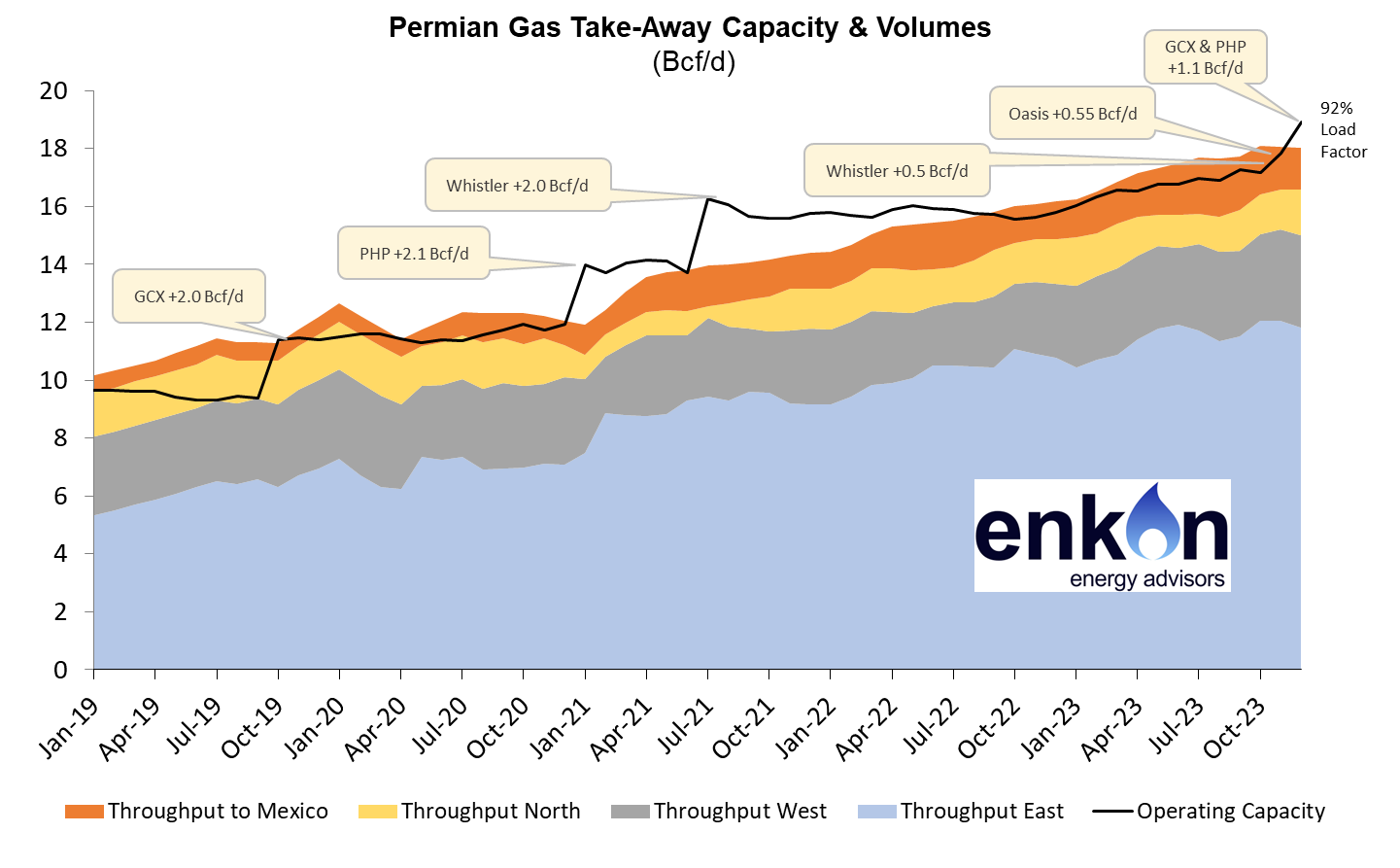
Despite adding nearly 8 Bcf/d of new takeaway pipeline capacity during this period, the persistent tightness in gas pipeline takeaway has affected gas prices in the Permian, with prices at the Waha hub trading below zero on several occasions in the first quarter of 2024. The addition of new gas pipeline capacity would provide access to growing LNG and industrial markets along the U.S. Gulf Coast. The 580-mile Matterhorn Express Pipeline, designed to transport up to 2.5 Bcf/d of natural gas from the Permian Basin to the Katy area near Houston, Texas, will offer crucial takeaway capacity. Other pipeline projects are less advanced and unlikely to alleviate the situation within the next 24 months.
Surge in New Gas Processing Capacity
Since over 95% of natural gas produced in the Permian is NGL-rich, it requires processing before it can be marketed to end-users on the U.S. Gulf Coast. The surge in new processing capacity, typically with 60-70% minimum volume commitments from producers, indicates that natural gas production from the Permian is expected to increase in alignment with the commercial in-service dates of the Matterhorn gas pipeline. Producer-backed firm plans to add gas processing capacity in the Delaware and Midland basins suggest significant growth in gas, NGL, and crude oil production as we approach the end of 2024.
To date, there have been announcements of eight greenfield plant additions and eleven brownfield capacity expansions planned over the next two years. If all these processing projects materialize, gas processing capacity in the Permian Basin will increase by 4.5 Bcf/d within the next 24 months. Of this increase, approximately 1.9 Bcf/d will be in the Delaware Basin, 1.5 Bcf/d in the Midland Basin, and less than 0.1 Bcf/d in the Central area. These capacity additions will ensure adequate processing capacity for projected wet gas growth during this period.
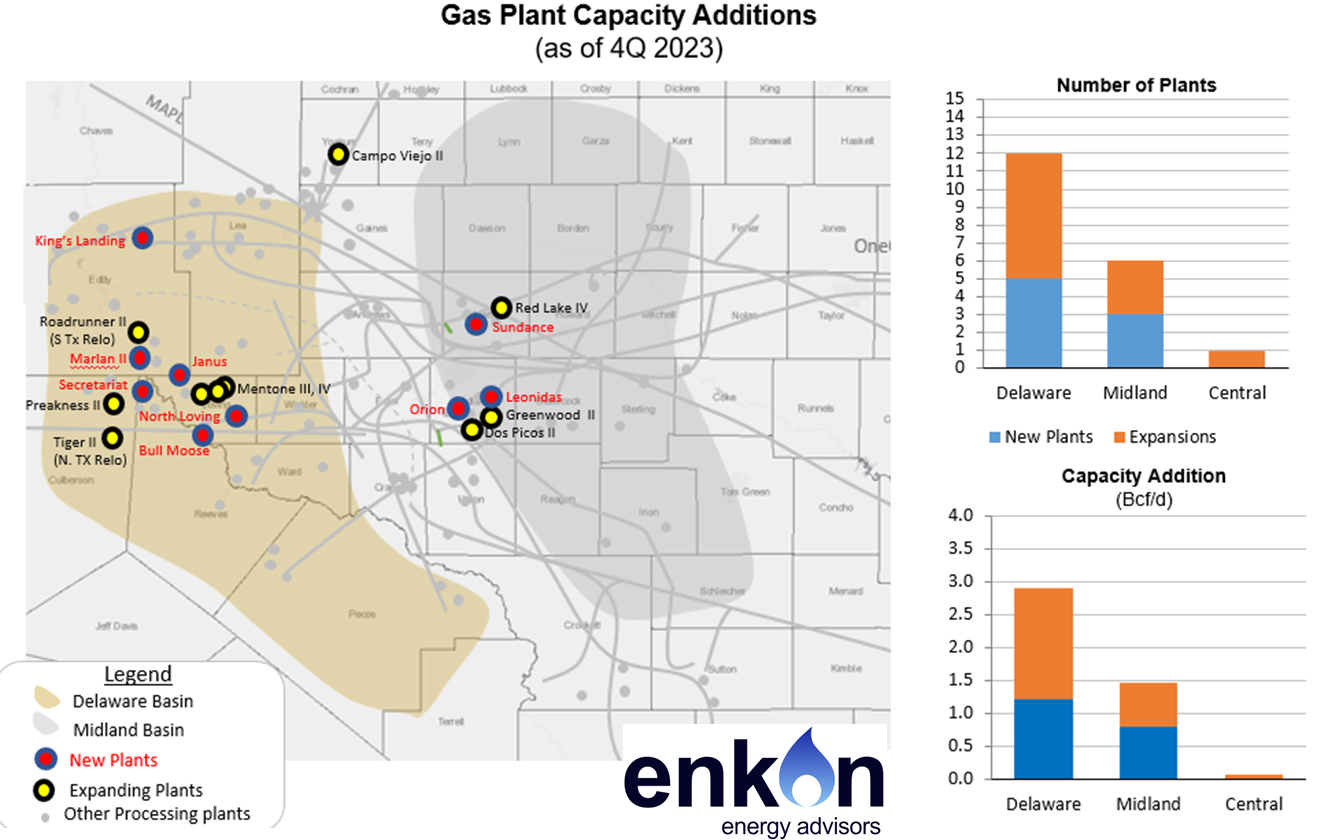
Another critical factor in the siting of new gas processing plants in the Permian is the Gas-to-Oil Ratio (GOR), defined as the amount of gas produced per barrel of crude oil. Due to ongoing issues with gas takeaway capacity, producers have focused on areas with lower GORs. The central and eastern flanks of the Delaware and much of the Midland Basin have GORs ranging from 0 to 2.5 gallons per minute (GPM), while the western flank of the Delaware Basin is “gassier” with GORs ranging from 3.0 to 6.0. Consequently, the planned processing capacity buildout is concentrated in the eastern flanks of the Delaware and the Midland Basin.
Production Implications
As Permian producers primarily drill for crude oil, the surge in gas processing capacity projects, fully backed by producers, suggests definite plans to increase Permian crude oil production. Adequate gas processing, natural gas pipeline takeaway, NGL pipeline takeaway, and downstream NGL fractionation are prerequisites for timely crude oil monetization from the Permian. Therefore, we expect a significant lift-off in hydrocarbon production (crude oil, NGLs, and natural gas) from the Permian as we enter 2025.
Lastly, the aggregate new capacity for gas processing exceeds new gas pipeline capacity, indicating that the Matterhorn pipeline will likely reach full capacity quickly. Consequently, another major pipeline expansion will be necessary post-2026 to enable continued growth from the Permian Basin. Several gas pipeline projects are potential candidates to cross the final investment decision (FID) line, with market access being a key differentiator. We anticipate positive FID announcements for at least one gas pipeline project in the second half of 2024.
-Amol Wayangankar
If you are interested in Permian natural gas/NGLs outlook and obtaining a detailed analysis on the overall investment risk in this sector, please contact us at info@enkonenergy.com. We encourage you to subscribe to our articles to get weekly articles via email.
Enkon Energy Advisors is a boutique consulting firm specializing in oil & gas, and energy transition since 2012. We bring deep expertise in a range of markets including natural gas, NGLs, Oil, LNG, and Energy Transition where we provide commercial and market advisory to investors, energy companies, and project developers with consulting services, subscription reports, and analytics, with the goal of delivering commercially actionable outcomes to our client.