Last month, we shared our insights on how clean ammonia is emerging as a crucial element in the U.S. energy transition. Boosted by IRA tax credits, clean ammonia is becoming a leading play in global decarbonization, particularly in hard-to-abate sectors. Unlike other nascent clean hydrogen markets, the export of clean hydrogen (in the form of ammonia) is driven by demand, particularly from the agricultural sector in Europe and coal plants in Japan and South Korea seeking to co-fire with clean ammonia to reduce coal usage.
Numerous memoranda of understanding (MOUs), letters of intent (LOIs), and some firm sales and purchase agreements have been executed with clean ammonia export projects in the U.S. Gulf Coast (USGC). However, many clean hydrogen projects are still in the pre-front-end engineering design (pre-FEED) or FEED phases, with final investment decisions several years away. For clean ammonia to realize its full potential as a key enabler of a greener future, the economics of producing, storing, transporting, and exporting clean hydrogen/clean ammonia must be competitive. This week, we examine the value chain economics of producing clean hydrogen from renewable sources such as solar and wind in the USGC and the cost competitiveness of delivering such clean hydrogen to key export markets.
Impact of IRA Tax Credits
The Inflation Reduction Act (IRA) provides significant government funding, tax credits, and other incentives to position the U.S. as a leading clean hydrogen and clean ammonia exporter from the USGC. Under the IRA 45Q/45V tax code, renewable electricity and clean hydrogen plants can receive a production tax credit of 2.6 cents per kWh and up to $3 per kg of hydrogen (base year 2023), respectively, for the first 10 years of operation. Producers of hydrogen made from renewable electricity qualify for both tax credits. Additionally, the hydrogen tax credit is “direct pay” for the first five years, allowing clean hydrogen producers to claim a tax refund equal to their tax credits. Moreover, both renewable electricity and clean hydrogen producers can benefit from tax “transferability,” enabling producers with no tax burden to sell their tax credits to a buyer who owes taxes.
USGC Clean Ammonia Production Cost
An off-grid, renewable power-driven hydrogen facility in the USGC feeding a greenfield ammonia production facility with access to an export terminal was modeled to quantify the breakeven cost of production. The start date was assumed to be post-2028/29. Under certain assumptions regarding construction costs, operating costs, commercial risk, financing, and operating assumptions, the Free-on-board (FOB) cost of producing and transporting clean ammonia to an export dock is estimated at approximately $4.60/kg of H2 to achieve a post-tax, unlevered 12% return on investment (breakeven cost expressed as $/kg of hydrogen equivalent).
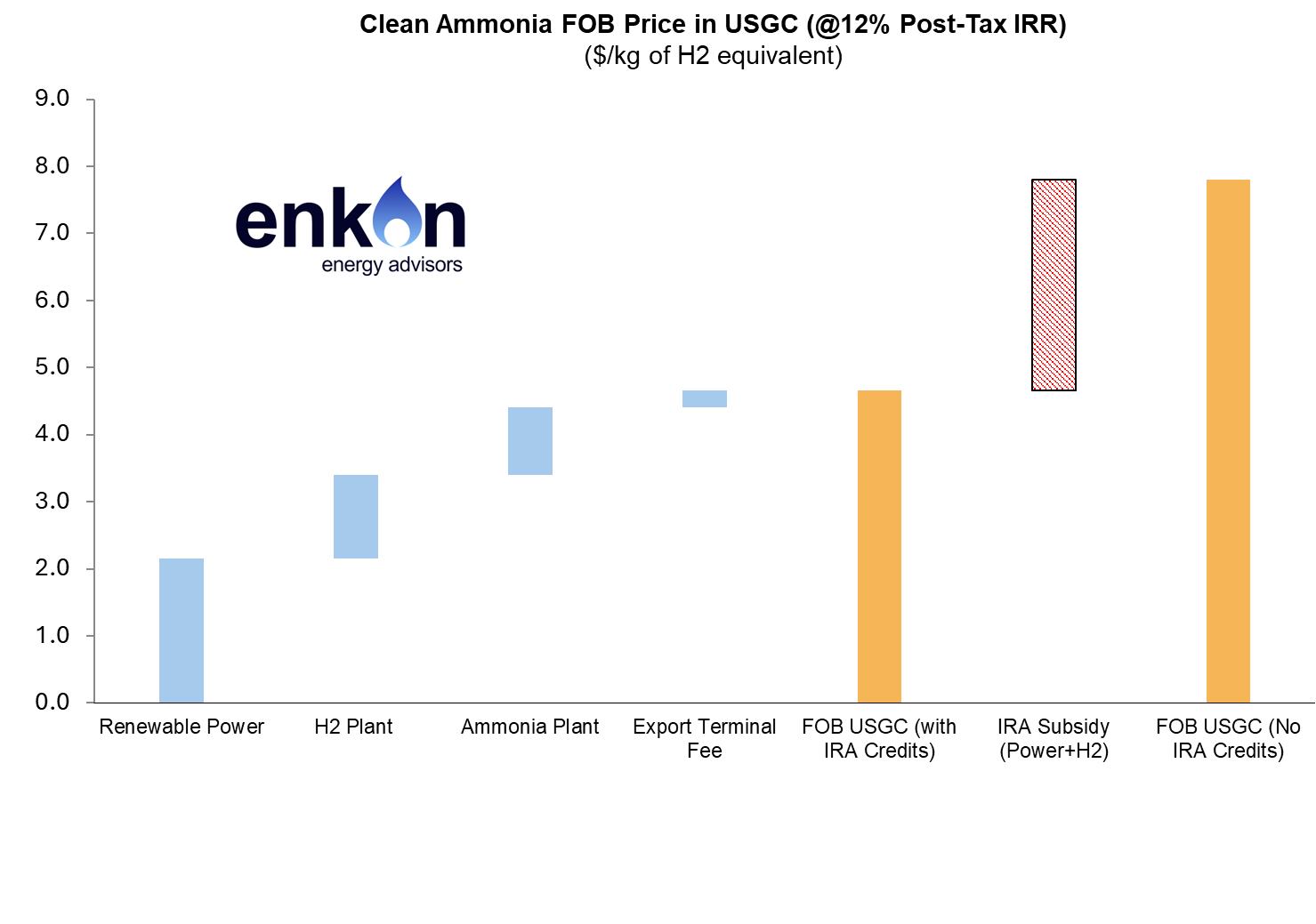
The breakeven analysis assumes a carbon intensity of less than 0.45 kg CO2e per kilogram of hydrogen (kg H2), the level of emissions needed to receive the highest tier of the 45V Hydrogen Production Tax Credit (PTC) under the IRA. Without IRA tax credits, the cost of producing clean ammonia to achieve a 12% return on investment increases to $7.8/kg of H2. This significant difference in breakeven costs highlights the impact of the IRA in promoting clean hydrogen production and reducing production costs.
Competitiveness of U.S. Clean Ammonia
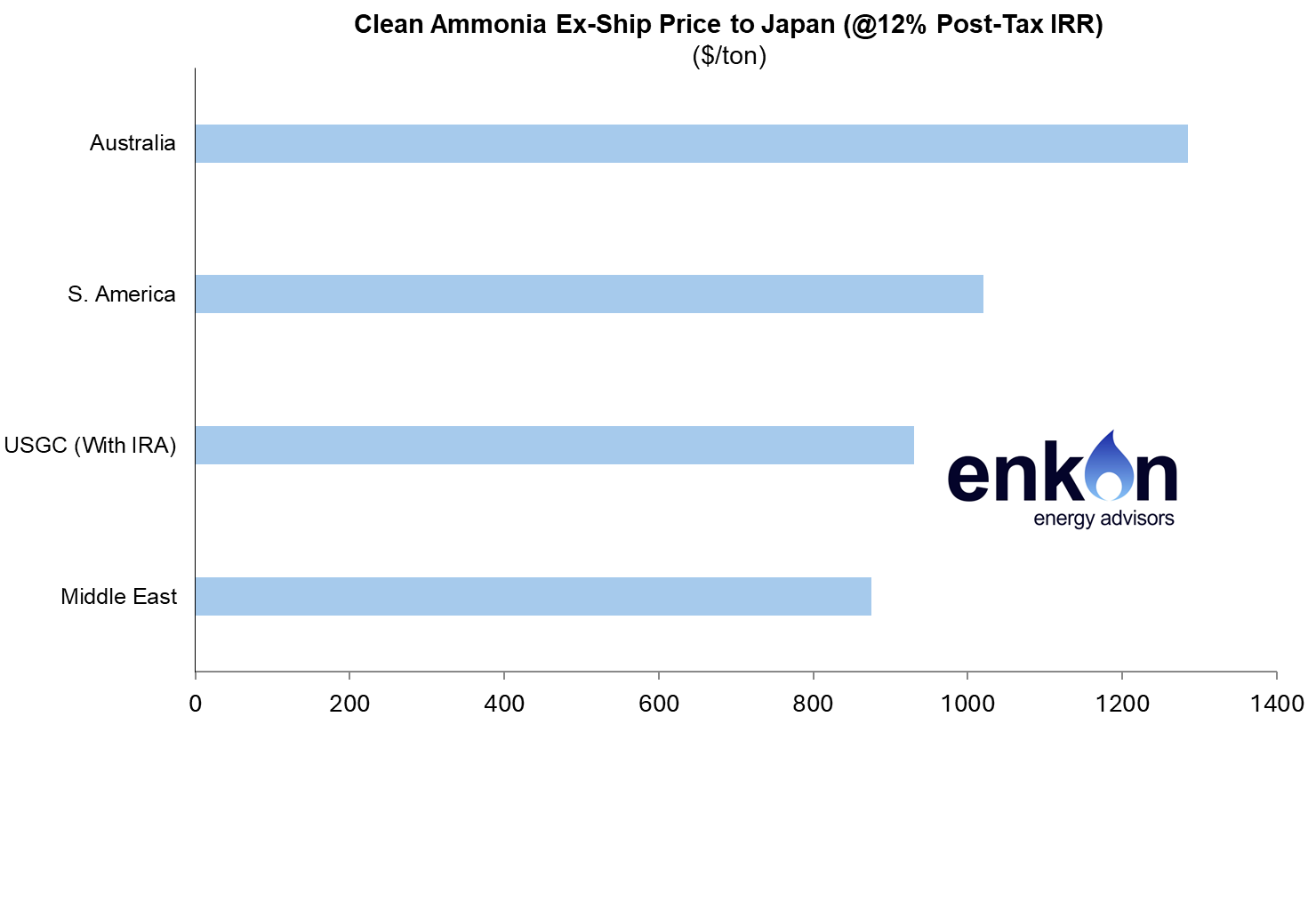
IRA tax credits have the potential to make USGC-produced clean ammonia among the most competitive in the world. Comparative economic analysis indicates that green ammonia produced in the USGC can be delivered to Far East Asia at lower costs than exports Australia, and South America and comparable to Middle East. The modeled breakeven costs to achieve a 12% after-tax unlevered return from the USGC to Japan are anticipated to be $930 per ton of clean ammonia (with IRA credits), roughly comparable to exports from the Middle East and approximately $150 less than the second most competitive region, South America. If project developers and sponsors in the USGC can manage CAPEX, offtake, and other development risks, the IRA is poised to be a game-changer for clean ammonia/hydrogen markets.
Conclusion
There is general consensus amongst market participants that IRA is a game changer. It has provided a level playing field, reducing the cost of clean hydrogen enough to make a meaningful inroad into hard-to decarbonize sectors. While IRA is sending a promising signal on clean hydrogen, a clean hydrogen economy remains far from reality in the United States; even with the tax credits, clean hydrogen is not a silver bullet for every sector (we will cover low-carbon ammonia export economics in a follow-up blog).
-Amol Wayangankar
If you are interested in the U.S. Clean Ammonia Outlook and obtaining a detailed analysis on the implications of IRA and economics of clean ammonia value chain, please contact us at info@enkonenergy.com. We encourage you to subscribe to our articles to get weekly articles via email.
Enkon Energy Advisors is a boutique consulting firm specializing in oil & gas, and energy transition since 2012. We bring deep expertise in a range of markets including natural gas, NGLs, Oil, LNG, and Energy Transition where we provide commercial and market advisory to investors, energy companies, and project developers with consulting services, subscription reports, and analytics, with the goal of delivering commercially actionable outcomes to our client.