Growth in hydrocarbon production continues to impress the markets despite capital discipline shown by oil and gas producers. While U.S. producers have maintained strict capital control, production is still increasing at an extraordinary pace. For instance, Permian natural gas production has surged by ~3.6 Bcf/d from 1Q 2023 through Q4 2024, with forecasts suggesting an additional increase of 11 Bcf/d through 2034, nearly all of which will be NGL-rich gas. Meanwhile, crude oil production has risen by ~0.6 million barrels per day in the same timeframe and is expected to grow another 1.9 million barrels per day through 2034. With increased drilling and increasing gas-to-oil ratios (GORs) from existing wells, this growth is expected to continue, supported by much needed addition of gas, NGL and crude pipeline capacity from the Permian. But what does this mean for NGLs, particularly Mont Belvieu fractionation complex’s ability to accommodate this influx of Y-grade NGL volumes not just from the prolific Permian but also from other NGL producing regions? What are the implications on spot T&F rates for fractionation?
The Mega-NGL pipeline buildout paves the way for Gulf Coast fractionation
Since the Permian shale boom began, U.S. Gulf Coast (“USGC”) operators have significantly expanded regional Y-grade pipeline takeaway capacity and also added NGL fractionation capacity at Mont Belvieu and Sweeny. The relentless rise in natural gas production continues to fill incremental pipe capacity additions from key NGL producing regions and downstream fractionation capacity at Mont Belvieu/Sweeny. With the recent additions of 0.6 MBPD in Q3-Q4 2024 of Permian Y-grade capacity, capacity utilization has eased from 95% in 2Q 2024 down to 85% utilization in Q4 2024. However, individual pipelines experienced varied utilization rates, ranging from 54% to 100%. If wet gas production growth maintains its current trajectory and/or if ethane demand increases, with the planned capacity additions NGL Y-grade pipeline capacity in aggregate will be sufficient until into 2032. Individual pipelines will likely continue to vary in utilization rates with some pipelines at capacity.
Pipeline companies have been anticipating this expected volume growth. In addition to the recent capacity additions, there are plans in place to add another 0.9 Million bpd of greenfield and brownfield NGL pipeline capacity out of the Permian basin by end of 2026.
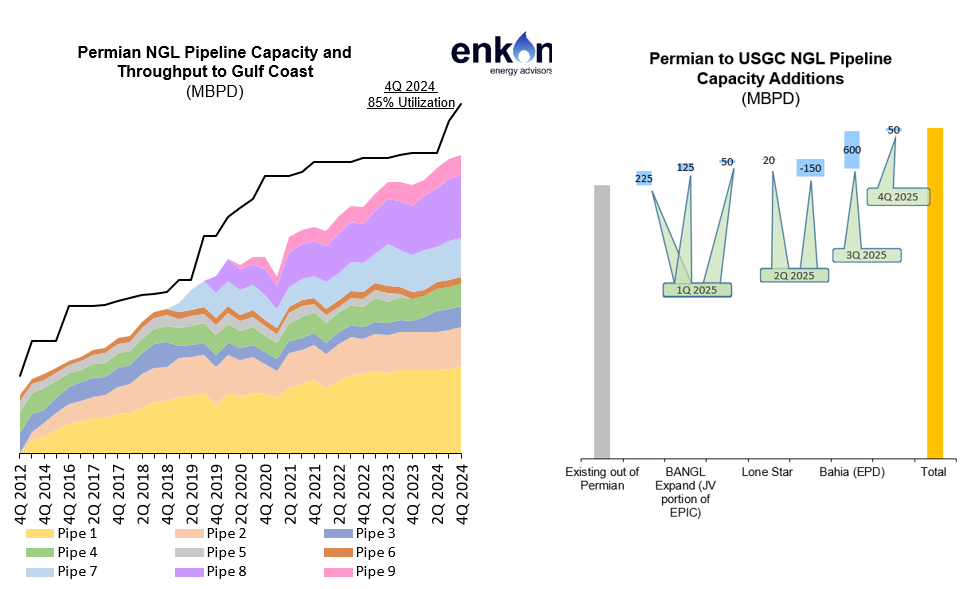
Our analysis suggests that the capacity additions should clear the way for aggregate Permian NGL pipeline volumes to flow unobstructed to Mont Belvieu/Sweeny region for the foreseeable future. With a looming oversupply of NGL take-away capacity through 2030, NGL transportation value from the Permian basin may come under pressure on some pipelines as pipeline companies try to attract the Y-grade NGL barrels to fill their pipeline space.
Mont Belvieu/Sweeny Fractionation Capacity Outlook
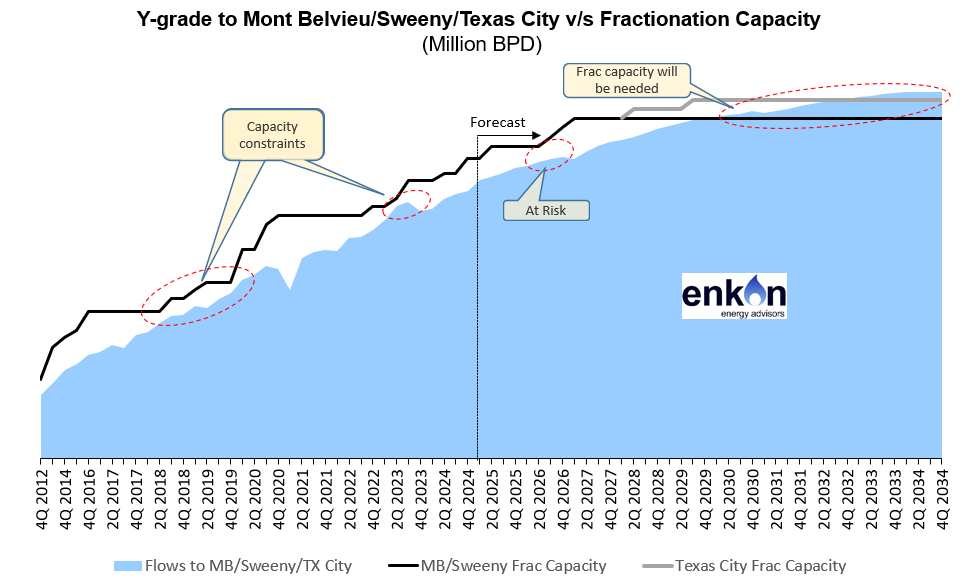
On the fractionation side, the Mont Belvieu/Sweeny region’s fractionation capacity remains highly utilized, despite the addition of 0.5 MBPD in 2024. Similar to NGL pipelines, an additional 660 MBPD of fractionation capacity is planned for Mont Belvieu by Q1 2027. Key expansions include Enterprise’s Unit 14 (+195 MBPD) set for service in Q2 2025, Energy Transfer’s Unit 9 (+164 MBPD) scheduled for completion in Q4 2026, and Targa Cedar Bayou’s Units 11 & 12 (+300 MBPD) slated for service in late 2026 and early 2027. These expansions are crucial to mitigating the risk of a fractionation capacity shortage through 2028, which could lead to volatile spot fractionation rates.
New Entrants in Texas City
BANGL JV (MPLX to be 100% stakeholder on acquisition closing July 2025) is planning to add 150 MPBD capacity in their segment of the EPIC pipeline from Permian to Gardendale, TX, which is in the Eagle Ford basin. With their planned expansion of this capacity, they will have a total of 300 MPBD NGL transport capacity on that line to Gardendale by end of 2025. BANGL JV also has plans to build an NGL pipeline from Gardendale through the Eagle Ford to Sweeny, Mont Belvieu and Texas City with capacity of 300 MBPD planned for service in the second half of 2026. Additionally, MPLX will be building two 150 Mb/d fractionators at Texas City with the first set to come online in 2028 and the second in 2029. Once completed, these additions will provide 300 MBPD of new pipeline capacity to the Gulf Coast and 300 MBPD of new fractionation capacity at Texas City.
With the aforementioned capacity additions at Mont Belvieu and Texas City, it appears that in aggregate, the combined fractionation capacity in Mont Belvieu, Sweeny and Texas City is expected to be sufficient to handle all volumes directed to the upper Gulf Coast for fractionation into 2030.
Conclusion:
Historically, Mont Belvieu’s fractionation capacity expansions have successfully avoided long-term bottlenecks. As we move through 2025, the likelihood of widespread capacity constraints has diminished. Despite this, fractionation facilities with strong upstream NGL value chains (from gas processing to fractionation) could still experience localized capacity challenges during this period. Effectively managing these risks will be key to optimizing operations and ensuring favorable financial outcomes.
-Sue Neville
If you are interested in a deeper dive into Permian pipeline NGL takeaway and Mont Belvieu NGL fractionation outlook, please contact us at info@enkonenergy.com. We encourage you to subscribe to our articles to get weekly articles via email.
Enkon Energy Advisors is a boutique consulting firm specializing in oil & gas, and energy transition since 2012. We bring deep expertise in a range of markets including natural gas, NGLs, Oil, LNG, and Energy Transition where we provide commercial and market advisory to investors, energy companies, and project developers with consulting services, subscription reports, and analytics, with the goal of delivering commercially actionable outcomes to our client.