
Natural gas storage is often viewed as critical infrastructure, particularly during periods of peak demand. In regulatory proceedings before the Federal Energy Regulatory Commission (FERC), market power analyses are routinely conducted to evaluate whether storage operators can exert control over pricing or access. These assessments consistently reinforce a key conclusion: storage markets are characterized by low concentration and limited ability for any single operator to exercise market power. This outcome is not driven by regulation alone. It reflects the underlying structure of the market, where storage competes within a broader and highly flexible system of supply, transportation, and alternatives.
The competitive landscape is further reinforced by development of new storage capacity across the U.S. Gulf Coast. As shown in Figure 1, a wide range of projects are currently under construction, recently commissioned, or in earlier stages of development.
Figure 1: USGC Gas Storage Projects Under Development (as of April 2026)
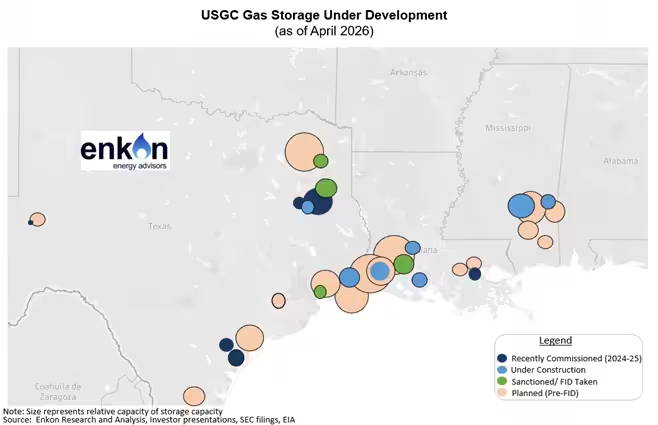
These projects are dispersed across key producing and demand regions, reflecting sustained investment, multiple active developers, and the absence of market barriers to entry (geological barriers remain). The steady addition of new capacity further dilutes market share and limits the ability of any individual operator to exert market power.
A Market Defined by Optionality
Storage provides the ability to shift gas over time, injecting during periods of low demand and withdrawing when demand increases. While valuable, this service is not unique. Customers leasing storage capacity have multiple alternatives, and those alternatives constrain pricing power.
Local production is one of the most important substitutes. In major producing regions, flowing gas volumes often exceed storage deliverability, allowing supply to respond directly to market demand. During peak periods, production can meet incremental needs without relying solely on stored gas. These dynamic places a natural ceiling on the value storage operators can extract from the market.
Pipeline connectivity further reinforces competition. Extensive interconnections between pipelines and market hubs allow gas to move efficiently across regions, giving shippers access to multiple sources of supply. Buyers are rarely dependent on a single storage facility, as they can route gas through alternative paths or access different hubs altogether.
In addition, storage competes with other operational tools such as pipeline line pack and interruptible transportation. While these are not perfect substitutes, they provide incremental flexibility that reduces reliance on storage alone. The result is a system where storage is important, but not indispensable.
Measuring Market Power in Storage
The conclusion that storage markets are competitive is supported by standard analytical frameworks used in regulatory proceedings, including those applied by the Federal Energy Regulatory Commission. These frameworks evaluate market power through market definition, market share, and market concentration.
Market shares are typically calculated using metrics such as working gas capacity and daily deliverability. Across most storage markets, individual facilities account for only a small portion of total capacity. It is common for a single operator to hold less than five percent of the market, with many participants falling closer to one to three percent. These low shares indicate that no single operator is positioned to influence pricing or restrict access in a meaningful way. Market concentration is assessed using the Herfindahl-Hirschman Index (HHI), which measures the distribution of market shares across participants
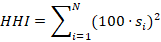
In practice, HHI levels in storage markets are typically well below thresholds associated with market power concerns. Even under conservative assumptions, such as limiting the market to existing storage facilities, concentration remains moderate. As the market definition expands to reflect real-world conditions, concentration declines further.
Why Market Definition Drives the Result
A key insight in storage market analysis is that outcomes depend heavily on how the market is defined. Narrow definitions can overstate concentration by excluding relevant sources of competition, while broader definitions provide a more accurate representation of market dynamics.
Including local production is particularly important. Production volumes are large, responsive, and directly competitive with storage deliverability. When production is incorporated into the market, the total supply base expands significantly, reducing the relative share of any individual storage operator. This results in a meaningful decline in measured concentration.
Similarly, accounting for new and under-construction storage capacity reflects the dynamic nature of the market. Additional capacity increases competition over time and further dilutes market share. Across broader definitions, the pattern is consistent: concentration decreases, and competitive conditions become more evident.
Conclusion
Natural gas storage markets are competitive by design. Fragmented ownership, strong substitution from local production, and extensive pipeline connectivity combine to limit the ability of any single operator to exercise market power.
As a result, storage providers operate within a system where pricing and access are driven by market fundamentals rather than dominance. Storage remains essential to system reliability, but it does not control the market.
-Andrea Linares
If you are interested in diving deeper into gas storage markets, please contact us at info@enkonenergy.com. We encourage you to subscribe to our articles to get weekly articles via email.Enkon Energy Advisors is a boutique consulting firm specializing in oil & gas, and energy transition since 2012. We bring deep expertise in a range of markets including natural gas, NGLs, Oil, LNG, and Energy Transition where we provide commercial and market advisory to investors, energy companies, and project developers with consulting services, subscription reports, and analytics, with the goal of delivering commercially actionable outcomes to our client.