
Introduction
The Permian Basin’s production ceiling has rarely been dictated by the quality of its rock, but rather by the diameter of its steel. As the premier driver of U.S. shale growth, the basin consistently pushes against the physical limits of its midstream infrastructure. Because the vast majority of Permian natural gas is associated gas—produced concurrently with highly profitable crude oil—a bottleneck in natural gas takeaway effectively acts as a choke valve on oil output. Producers facing strict flaring regulations cannot drill for oil if they have nowhere to send the gas. However, a massive new wave of natural gas pipeline capacity is currently moving from final investment decisions to steel in the ground. While this impending gas egress will clear the basin’s immediate structural constraints, it guarantees the creation of a new one: a rapid acceleration in crude oil production that will soon overwhelm the existing liquids takeaway infrastructure.
The Gas Pipeline Buildout: Pushing the Ceiling
As illustrated in the image, Permian outbound natural gas flows are projected to climb relentlessly from roughly 20 Bcf/d in the second half of 2026 to nearly 33 Bcf/d by 2035. Historically, the margin between outbound flows and the 95% design capacity threshold has been razor-thin, frequently leading to constrained production and severe gas basis blow out at the Waha gas hub.
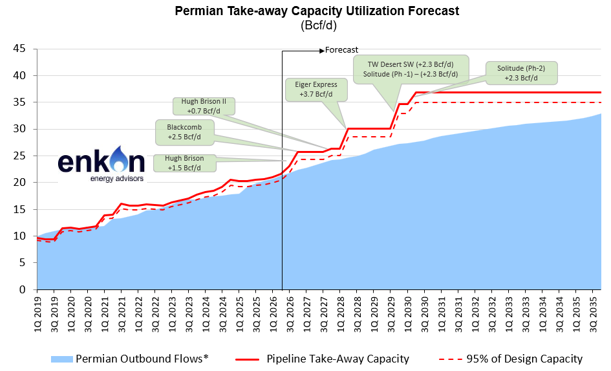
To keep pipeline takeaway capacity ahead of this surging volume, the midstream sector is executing a sequential, multi-year capacity expansion that will lift total takeaway capacity to nearly 37 Bcf/d by the early 2030s:
- Hugh Brison & Blackcomb: The near-term pressure is being alleviated by the Hugh Brison pipeline, expected to provide an initial +1.5 Bcf/d of capacity. This is followed closely by the Blackcomb pipeline, adding another +2.5 Bcf/d of gas egress. An expansion, Hugh Brison II, is slated to add a sequential +0.7 Bcf/d.
- Eiger Express: A massive +3.7 Bcf/d addition is anticipated around mid-2028. This significantly widens the egress corridor, pushing total basin takeaway capacity beyond the 30 Bcf/d mark.
- TW Desert SW: This project will provide an additional +2.3 Bcf/d of capacity in the late 2029 timeframe.
Backlog Has the Solitude Effect: Expanding the Long-Haul Corridor the Scarce Asset
The true long-term relief for the basin arrives at the turn of the decade with the Solitude Pipeline system. Designed as a scalable, long-haul transportation solution, Solitude will connect expanding Permian supply directly with surging demand centers and LNG export terminals along the U.S. Gulf Coast.
The project is structured in phases to match the basin’s output trajectory. As shown in the image, Solitude (Phase 1) is expected to arrive in tandem with TW Desert SW in the late 2029 timeframe, adding a critical +2.3 Bcf/d of capacity. As outbound flows continue to press upward into the 2030s, Solitude (Phase 2) will deliver another +2.3 Bcf/d, providing the final major capacity step-up in the current forecast. Together, these additions ensure total pipeline takeaway capacity maintains a healthy, structural margin above the 95% utilization threshold through 2035.
The Unintended Consequence: The Coming Crude Bottleneck
By solving the natural gas equation, the midstream sector is quietly setting the stage for the next infrastructure reckoning. The elasticity of Permian crude production has been artificially depressing by the lack of gas takeaway. With projects like Blackcomb, Eiger Express, and the phased Solitude pipeline securing the gas runway, operators are unbridled to maximize crude extraction without the threat of flaring limits or stranded associated gas.
This dynamic dictate that Permian crude oil production will structurally and sharply rise as the gas bottlenecks disappear. Current crude pipeline capacity from the Permian to the Gulf Coast—already operating at high utilization rates—will tighten much faster than the consensus base case anticipates under this unconstrained production profile.
As the new natural gas pipelines enter service and capacity utilization drops back into comfortable territory, the industry’s capital focus must rapidly pivot. Midstream players and producers alike must now prepare for the inevitable: the next major infrastructure cycle will not be centered on natural gas, but on the urgent need for expanded crude oil egress.
-Kush Thakkar
If you are interested in the U.S. energy outlook and obtaining a detailed analysis on the implications of the current market environment, please contact us at info@enkonenergy.com. We encourage you to subscribe to our articles to get weekly articles via email.
Enkon Energy Advisors is a boutique consulting firm specializing in oil & gas, and energy transition since 2012. We bring deep expertise in a range of markets including natural gas, NGLs, Oil, LNG, and Energy Transition where we provide commercial and market advisory to investors, energy companies, and project developers with consulting services, subscription reports, and analytics, with the goal of delivering commercially actionable outcomes to our client.