U.S. hydrocarbon production continues to grow, even amid disciplined capital spending by oil and gas producers and increasing cost structures due to fast evolving Tariff situation. The Permian shale play stands out as a major contributor to this expansion, defying expectations and consistently boosting hydrocarbon output despite cost pressures. It is therefore no surprise that midstream companies are relying on Permian for organic growth across commodities including Natural Gas Liquids (NGLs). Understanding and navigating the complexities of the evolving NGL takeaway pipeline situation from the Permian Basin is essential for stakeholders across the energy sector to effectively manage risks, safeguard commodity values/netbacks and capitalize on growth opportunities in this dynamic environment. It appears that NGL takeaway concerns may not dominate the headlines for the next few years.
Current Permian NGL Pipeline Egress
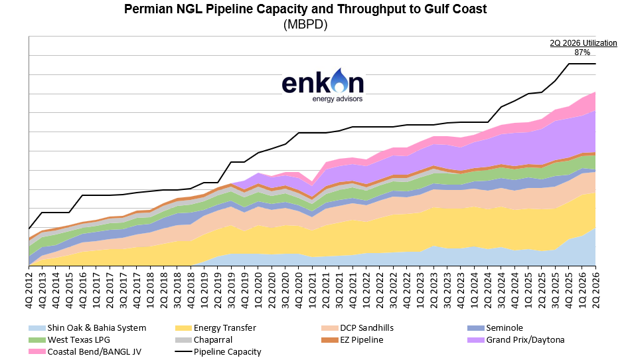
As of 2Q 2026, aggregate NGL pipeline capacity downstream of the Permian Basin stands at approximately 87% utilization. Recent and planned pipeline expansions are providing meaningful relief and enhancing flow assurance and flexibility for gas producers. Notable incremental NGL pipeline projects include:
- ET: Lone Star Express added 90 MBPD in 4Q 2025 through pump/filter upgrades, with another 150 MBPD from looping planned for 1H 2027. The additional capacity is upstream into the West Delaware Basin only, not through to Mont Belvieu.
- BANGL JV: Capacity is 250 MBPD, with an expansion to 300 MBPD expected in 2H 2026. BANGL’s route out of the Permian includes an undivided interest in the Coastal Bend line (formerly EPIC Y-Grade) between Benedum and Gardendale, so the two systems share pipe on that stretch. MPLX also plans to extend BANGL beyond Sweeny to new Texas City fractionators due in 2028–2029, which adds Gulf Coast delivery options but no Permian takeaway.
- Targa: Commissioned the 500 MBPD Delaware Express intra-basin NGL pipeline and is developing the 500 MBPD Speedway pipeline for 3Q 2027 service.
Pipeline Utilization Disparities and Egress Risk
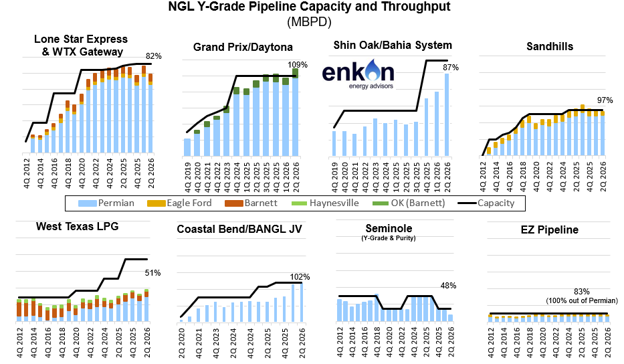
Despite availability of spare pipe capacity for Permian NGLs in aggregate, there are some significant regional disparities in utilization rates across key NGL pipelines. Among the nine major pipelines transporting NGLs from different sub-basins to Mont Belvieu/Sweeny fractionation hubs, three are currently operating at or near capacity. Monthly fluctuations in usage render some pipelines’ available capacities unpredictable, necessitating nuanced planning to protect NGL netbacks for producers.
Upcoming Incremental Capacity Additions
Expectations of favorable oil prices will likely continue to add significant NGL volumes out of Permian. Recent pipeline additions have provided meaningful relief, but will they address all of the basin’s future needs? Additional pipeline projects and expansions are underway, with capacity expected to come online in phases over the coming years to accommodate expected NGL growth.
With ample aggregate capacity projected beyond 2026, competitive dynamics among midstream operators are likely to intensify. Strategic positioning, customer retention, and asset utilization will become focal points as infrastructure providers work to secure throughput and protect market share.
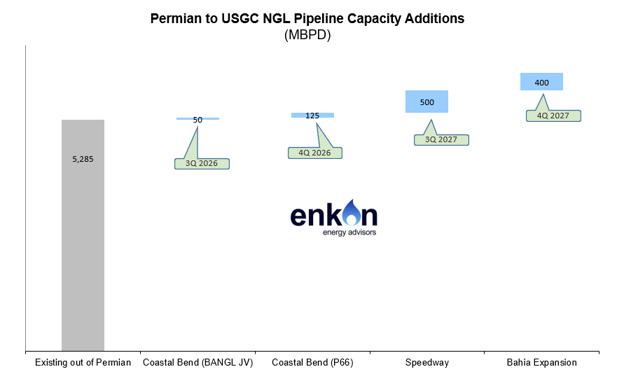
Though additional expansions underway look to solve the aggregate problem of getting NGL’s out of the Permian Basin, questions linger on long-term sufficiency in accommodating projected NGL growth in certain locations. Therefore, aligning NGL marketing strategies with market realities, such as securing firm transport capacity versus relying on walkup capacity, is pivotal.
Commercial Implications
Recent pipeline expansions have provided much-needed relief to the Permian NGL transport system, but risks remain—particularly on individual pipelines and regional corridors that are nearing full utilization. Producers and midstream operators reliant on these constrained systems continue to face exposure to bottlenecks, price discounts, and operational uncertainty. Key considerations include evaluating existing pipeline capacities, monitoring processing plant expansions, forecasting impacts of ethane extraction, and adapting swiftly to market shifts to maximize commodity value. Stay informed as Enkon continues to delve deeper into these critical dynamics in upcoming articles, offering insights and strategies to navigate the evolving landscape of Permian basin NGLs.
-Andrea Linares
If you are interested in Permian NGL outlook and obtaining a detailed analysis on the overall investment risk in this sector, please contact us at info@enkonenergy.com. We encourage you to subscribe to our articles to get weekly articles via email.
Enkon Energy Advisors is a boutique consulting firm specializing in oil & gas, and energy transition since 2012. We bring deep expertise in a range of markets including natural gas, NGLs, Oil, LNG, and Energy Transition where we provide commercial and market advisory to investors, energy companies, and project developers with consulting services, subscription reports, and analytics, with the goal of delivering commercially actionable outcomes to our client.