
U.S. hydrocarbon production continues its impressive growth trajectory despite stringent capital discipline exercised by oil and gas producers in recent years. The Permian shale play stands out as a major contributor to this expansion, defying expectations and consistently boosting hydrocarbon output. Notably, even as natural gas prices in the region occasionally dipped to near zero or even negative levels, Permian Natural Gas Liquids (“NGLs”) rich gas production continued to rise, primarily driven by the economics of crude oil. With crude oil prices staying in the $65-80/bbl goldilocks range, will capacity of downstream NGL infrastructure be adequate to accommodate this surge in Permian NGL volumes?
Understanding and navigating the complexities of the evolving NGL takeaway pipeline situation from the Permian Basin is essential for stakeholders across the energy sector to effectively manage risks, safeguard commodity values/netbacks and capitalize on growth opportunities in this dynamic environment. This article provides benchmarking and perspectives on NGL egress from the Permian.
Current Permian NGL Pipeline Egress
When it comes to pipeline take-away constraints out of the Permian, the spotlight has largely been on natural gas and less so on NGLs and crude. However, Permian NGL takeaway pipeline situation is not far behind given the possibility for positive FIDs on multiple expansions LPG/ethane export terminal expansions in the U.S. Gulf Coast. As of 1Q 2024, aggregate NGL pipeline capacity downstream of the Permian basin was operating at ~90% utilization, confirming the need for additional capacity to meet growing downstream demand. While expansions are underway, questions linger on their sufficiency in accommodating projected NGL growth. Therefore, aligning NGL marketing strategies with market realities, such as securing firm transport capacity versus relying on walkup capacity, is pivotal.
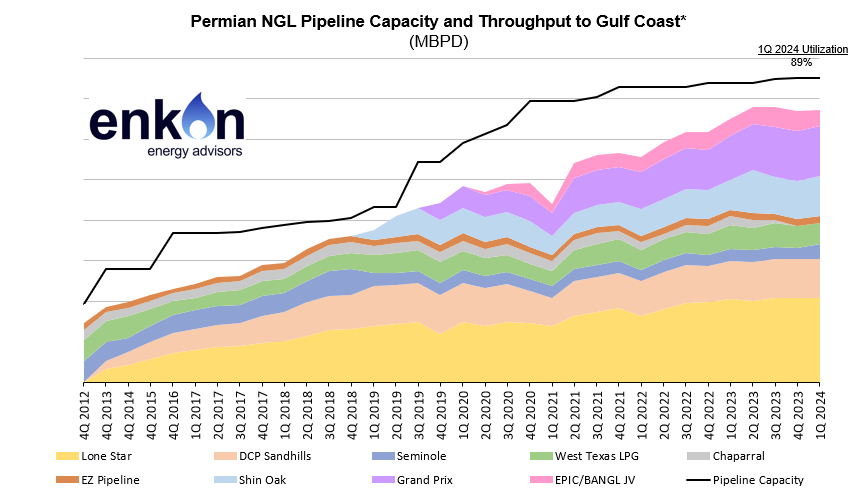
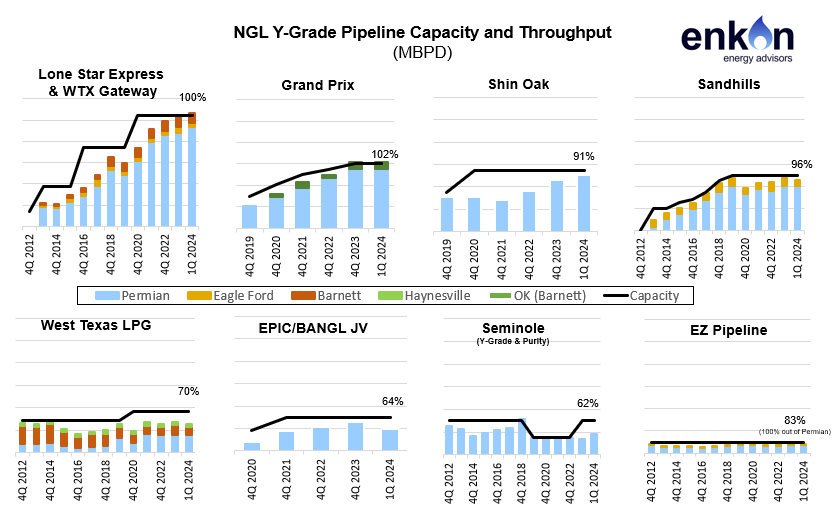
Despite an overall 10% capacity availability in 1Q 2024 for Permian outbound volumes (which we believe is already tight from an operational perspective), there are some significant regional disparities in utilization rates across key NGL pipelines. A total of Nine (9) pipelines from various basin locations transport NGLs towards fractionation hub in Mont Belvieu and Sweeny, each with unique capacities, flows, and expansion prospects. Four of the NGL pipelines out of the Permian Basin are operating at or near capacity. Monthly utilization fluctuations render some pipelines’ available capacities unpredictable, necessitating nuanced planning to protect NGL netbacks for producers
Upcoming Incremental Capacity Additions
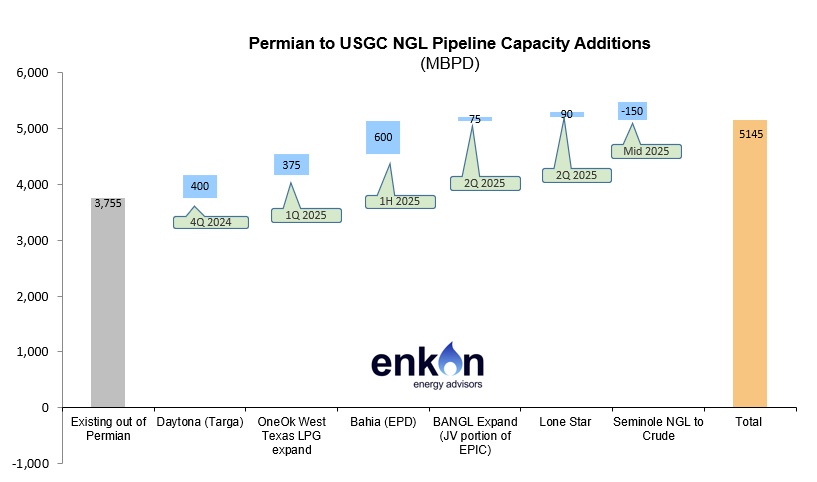
Expectation of favorable oil prices will likely continue to add significant NGL volume out of the Permian. Relief is coming as early as end of 2024 when Targa’s 0.4 Million BPD Daytona pipeline is expected to start service. However, this capacity is not coming until the end of 2024, so there is still significant short-term transport risk for NGLs out of the Permian. In aggregate, ~1.3 MMBPD of new pipelines and pipeline expansions have been announced advertised to be in service by Year end 2025 which will significantly relieve NGL take-away constraints for the foreseeable future. With ample take-away capacity projected post 2025, it would be interesting to see how key midstream players preserve and execute strategies to protect their NGL turf.
Ethane extraction is a silent variable
While significant volume of ethane is currently being extracted from the Permian as part of Y-grade NGL stream, there is ~0.4 Million BPD of ethane that is being rejected in the natural gas stream. With gas pipelines flowing at or exceeding max design capacities, there is a strong likelihood that the rejected ethane could show up in the Y-grade NGL stream, exacerbating the short-term risks on NGL egress from the Permian. In such a scenario, while aggregate NGL pipeline capacity out of the basin would closely match the Y-grade flows, multiple pipelines in the Permian may not be able to accommodate this ethane surge. The dynamics of ethane extraction is a silent element that could suddenly use all the excess NGL pipeline capacity counted on by the market. Parties need to be sure to factor in the potential threat of increased ethane extractions when lining up transportation for their downstream NGL’s.
Commercial Implications
In summary, while forthcoming NGL pipeline expansions promise relief, current and potential constraints necessitate comprehensive risk assessment and forward-thinking strategies. Key considerations include evaluating existing pipeline capacities, monitoring processing plant expansions, forecasting impacts of ethane extraction, and adapting swiftly to market shifts to maximize commodity value. Stay informed as Enkon continues to delve deeper into these critical dynamics in upcoming articles, offering insights and strategies to navigate the evolving landscape of Permian Basin NGLs.
-Sue Neville
If you are interested in Permian NGL outlook and obtaining a detailed analysis on the overall investment risk in this sector, please contact us at info@enkonenergy.com. We encourage you to subscribe to our articles to get weekly articles via email.
Enkon Energy Advisors is a boutique consulting firm specializing in oil & gas, and energy transition since 2012. We bring deep expertise in a range of markets including natural gas, NGLs, Oil, LNG, and Energy Transition where we provide commercial and market advisory to investors, energy companies, and project developers with consulting services, subscription reports, and analytics, with the goal of delivering commercially actionable outcomes to our client.