It is easy to forget about Eagle Ford shale play when you have Permian hydrocarbon production growing at astounding rate supported by continued capital inflow and robust M&A activity. While U.S. majors are pouring billions of dollars into the Permian Basin, international energy companies are all-in on the Eagle Ford Shale like U.K.-based BP which continue to pour investment into new drilling projects in the Eagle Ford. While hydrocarbon production is turning the corner in the Eagle Ford, its strategic proximity to LNG export facilities, crude exports, refining complex and NGL fractionation hubs (i.e. higher netbacks) along with sufficient take-away capacity for crude, natural gas and NGLs should provide tail winds for sustained growth in production. While it may still never be able to match the prolific Permian, Eagle Ford- version 2.0 cannot be ignored anymore.
Eagle Ford Production Trends
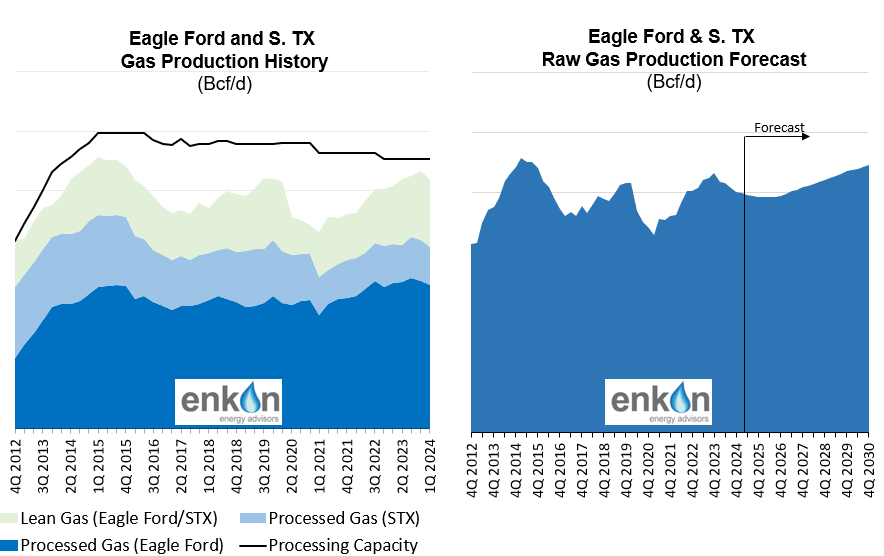
In the early years of the shale boom, Eagle Ford was touted to be a huge growth area for crude oil and natural gas. Production saw a significant increase from the Eagle Ford basin up through 2014 when the basin peaked. Following this peak, raw gas production (including NGLs) declined from a high of ~ 9 Bcf/d in 2014 to ~7 /Bcf/d in 2017. This decline was driven by a combination of falling prices due to a growing supply glut, lower demand, and deteriorating drilling economics. During this period, capital and interest were also being drawn to the more promising Permian Basin where producers were seeing prolific hydrocarbon output at significantly superior drilling economics.
The production decline continued until 2017, after which growth resumed as markets from LNG and crude oil exports began to take off. Just as production was returning and growing 2017-2020, covid hit bringing new challenges that resulted in further declines in gas production. With the easing of lockdowns and the gradual recovery of global supply and demand, Eagle Ford/STX production rebounded, with gas production increasing by 2.1 Bcf/d between 2021 and 2023. Given the inflow of capital and Eagle Ford’s strategic value proposition, Enkon Energy Advisors forecasts that Eagle Ford raw gas production (which includes South Texas non-shale portion) will rise again to match highs seen in 2015 at 9 Bcf/d by 2028.
Eagle Ford Advantages Driving Future Production Growth:
Multiple factors contribute to the anticipated growth in Eagle Ford/STX production:
- Strategic Location: The region’s proximity to LNG export terminals, major fractionation hubs, industrial markets and the Aqua Dulce natural gas hub offers a significant advantage. In addition, established infrastructure facilities are in place to move the products. This location provides better netbacks to producers for crude oil, natural gas and natural gas liquids than locations further from the coast. The cost savings in pipeline transportation fees support higher realized prices, and there are less pipeline take-away constraint problems for crude, gas and NGLs. With the rise in global demand for LNG, Eagle Ford/STX is in a strategic location to capitalize on increasing LNG export demands as well. Similarly, Eagle Ford is ideally positioned to meet growing crude oil exports.
- Technological Advancements: Improvements in drilling and completion techniques including longer laterals drilling, enhanced compression, and refracturing of first-generation wells are boosting production efficiency.
- Producer consolidations: Over the past few years, consolidations have led to the acquisition of smaller, pure-play Eagle Ford producers by larger companies. These larger entities, with better access to capital and advanced technologies, are positioned to leverage economies of scale and improve production efficiency in Eagle Ford.
Eagle Ford NGL landscape – Is there enough NGL take-away Capacity?
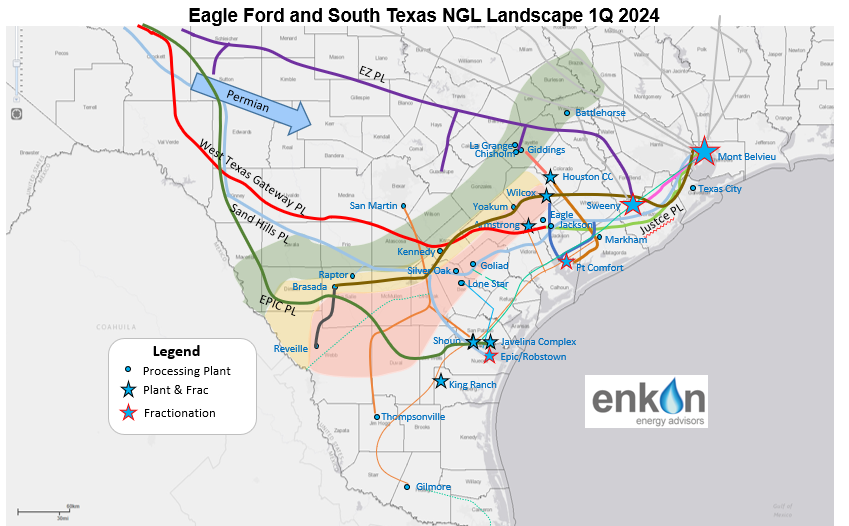
The Eagle Ford shale and its surrounding South Texas region currently produce approximately 8.5 Bcf/d of natural gas, of which around 75% is wet or NGL-rich gas. Wet gas is processed and moved to fractionation facilities in South Texas, Sweeny and Mont Belvieu. There are 12 midstream companies that provide gas processing in this area. Post consolidations and shutting down of older and less inefficient processing plants, the region now has gas processing capacity of approximately 9.0 Bcf/d from 26 active processing plants in the region, none of which have local fractionation capabilities. Y-grade NGLs are transported to major gulf coast fractionation facilities via both interstate and intra-state NGL pipelines. Four interstate pipelines originate in the Permian Basin and pick up more NGLs in the Eagle Ford area before terminating at major Gulf Coast fractionators.
NGL Pipeline Take-Away and Transportation Risks:
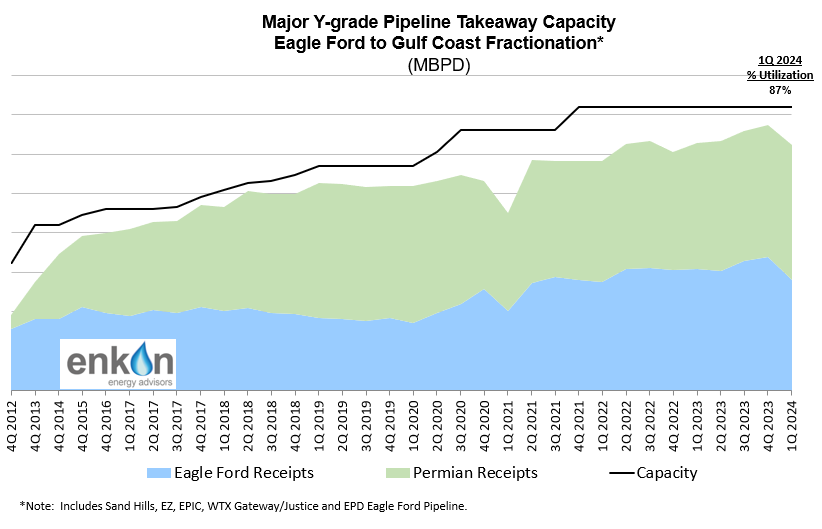
Rise in Eagle Ford NGLs production coupled with competition for pipeline space with NGLs originating in the Permian will likely test Eagle Ford NGL-pipeline take away capacity. As production rises and demand for ethane increases (increased utilization of existing and new steam crackers and increased exports), the associated NGLs will need to be transported out of the basin to downstream fractionation facilities. As of 1Q 2024, NGL pipelines out of Eagle Ford were utilized at an aggregate utilization rate of 87%, with two of these pipelines at capacity. The following graph shows the distribution of Permian verse Eagle Ford volumes on these NGL pipelines. Effective management of these transportation risks is crucial to safeguard production and maximize profits.
Conclusion:
The Eagle Ford is set to regain its 2015 production highs by 2028, driven by a steady rise in commodity prices, a strategic location, increasing global LNG demand, and advancements in drilling and completion technology. However, managing the transportation of associated NGLs will be vital to ensuring that production growth translates into profit. Producers must navigate pipeline capacity challenges and associated risks to optimize their operations and financial outcomes.
-Sue Neville
If you are interested in Eagle Ford NGL outlook and obtaining a detailed analysis of NGLs in each of the key basins, please contact us at info@enkonenergy.com. We encourage you to subscribe to our articles to get weekly articles via email.
Enkon Energy Advisors is a boutique consulting firm specializing in oil & gas, and energy transition since 2012. We bring deep expertise in a range of markets including natural gas, NGLs, Oil, LNG, and Energy Transition where we provide commercial and market advisory to investors, energy companies, and project developers with consulting services, subscription reports, and analytics, with the goal of delivering commercially actionable outcomes to our client.