
In recent weeks, diplomatic engagement between the United States and Russia has resumed at a cautious pace, with leaders exploring limited areas of cooperation even as tensions over Ukraine, sanctions, and broader security issues remain unresolved. Energy has inevitably entered the conversation, given Russia’s historical role as a dominant supplier of natural gas to Europe and the United States’ rise as the world’s leading LNG exporter. For U.S. LNG, the stakes are considerable: whether Russia is kept on the sidelines or allowed back into Western markets will shape export volumes, terminal expansions, and long-term investment in America’s gas sector.
Potentially High Stakes for U.S. LNG
The recent talks between the United States and Russia raised questions about their potential impact on global energy flows, but concrete outcomes remain elusive. Discussions reportedly touched on Arctic energy development and the possibility of Russian participation in infrastructure projects. Yet, with sanctions firmly in place, Russian natural gas remains largely excluded from Western markets. As a result, U.S. LNG continues to dominate, filling much of the gap left by Russia’s reduced pipeline and LNG exports to Europe. The U.S. is now the world’s largest LNG exporter, shipping nearly 12 Bcf/d in 2024. Europe absorbs most of these volumes, positioning American LNG as central to the continent’s energy security. However, the peace talks with Russia present the possibility of Russian supply returning to Europe if sanctions are eventually dropped. Should sanctions be eased, U.S. LNG could face stiff competition, reducing demand for long-term contracts and threatening billions of dollars in future investment. Conversely, if Europe continues to minimize reliance on Russia, American exporters will retain their advantage and expand further.
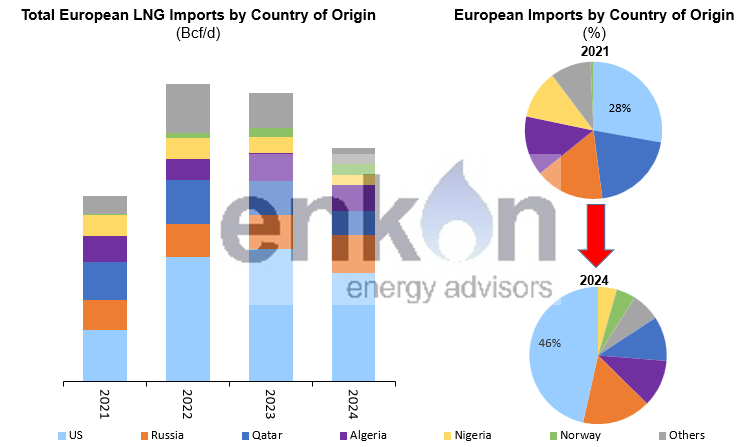
Although there is this uncertainty, we here at Enkon say it is unlikely that U.S. exports of LNG to Europe will heavily decline if Europe’s stance on Russia continues. The European Commission reaffirmed in June its commitment to ban all imports of Russian gas by 2028. Currently, Europe is attempting to reduce its carbon footprint and its reliance on gas imports, but as supply in the region continues to fall due to decreasing production – there is no strong suggestion of a significant decline in demand for U.S. LNG imports into Europe. In fact, our expectation is that a potential peace deal in the Ukraine war will only lead to piped Russian gas returning to around 30% (5.6 Bcf/d) of its 2017–2019 average of 18.6 Bcf/d by 2034.
Still, this global tension and perceived fragility directly affects the Gulf Coast export terminals that anchor U.S. LNG trade. Facilities in Texas and Louisiana have been running near full capacity to meet Europe’s demand, while investors weigh expansions and new project approvals. The viability of these projects hinges on Europe’s policy stance toward Russian gas. If Russian flows resume, expansion plans could stall; if not, more U.S. capacity will likely be sanctioned, reinforcing America’s role as the backbone of Europe’s LNG supply.
Asia, Latin America, and Beyond
While Asia has historically been a key LNG market, U.S. cargoes to the region have slowed due to high spot prices and rationed demand. That leaves Europe as the primary outlet. Should Russian gas regain access to Europe, U.S. exporters may attempt to redirect more cargoes to Asia, Latin America, or the Middle East. However, those markets are smaller in scale and less able to absorb large volumes, making Europe the critical arena where U.S.–Russia energy competition will play out most directly.
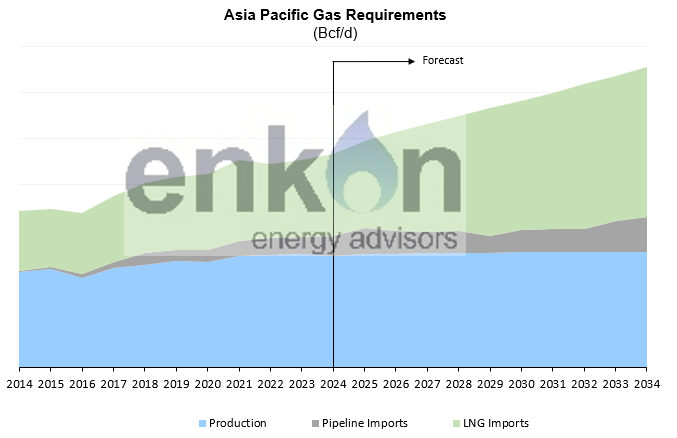
Looking at the future for Asia, there is a vast quantity of growth expected in China and other developing countries like India for LNG. Optimistically, there should be room for American volumes to go to other destinations besides Europe in the near future. But for now, U.S.–Russia talks have not altered LNG flows, and to many they underscore the fragility of U.S. dominance in global gas trade. Europe’s continued reliance on American cargoes sustains record exports, yet future volumes depend heavily on geopolitical choices. If Russian supply stays constrained, U.S. LNG stands to grow further; if sanctions ease, American exporters could face slower expansion and reduced investment. Until the policy path is clarified, U.S. LNG’s strength rests on Europe’s ongoing need for secure, non-Russian energy supplies.
Conclusion
- In conclusion, the outcome of U.S.–Russia diplomatic engagement remains uncertain, but its implications for global LNG markets are significant. For now, U.S. LNG maintains its lead as Europe’s primary supplier, yet future growth depends on whether Russian volumes re-enter the market and how quickly new American capacity comes online. The balance between geopolitics, infrastructure, and demand will define the next chapter in LNG trade. Key questions to consider include:
- Will Europe hold firm to its 2028 commitment to eliminate Russian gas imports, or will political pressure reopen the door to Russian supply?
- Can U.S. export terminals along the Gulf Coast expand fast enough to secure long-term dominance in the face of shifting global demand?
- How will rising LNG demand in Asia and other developing regions reshape trade flows if Europe’s reliance on U.S. cargoes begins to ease?
- Connor Pence
If you are interested in Permian crude oil outlook and obtaining a detailed analysis on the overall investment risk in this sector, please contact us at info@enkonenergy.com. We encourage you to subscribe to our articles to get weekly articles via email.
Enkon Energy Advisors is a boutique consulting firm specializing in oil & gas, and energy transition since 2012. We bring deep expertise in a range of markets including natural gas, NGLs, Oil, LNG, and Energy Transition where we provide commercial and market advisory to investors, energy companies, and project developers with consulting services, subscription reports, and analytics, with the goal of delivering commercially actionable outcomes to our client.