Despite stringent capital discipline exercised by oil and gas producers in recent years, U.S. hydrocarbon production continues its impressive growth trajectory. The Permian shale play stands out as a major contributor to this expansion, defying expectations and consistently boosting hydrocarbon output. Notably, even as natural gas prices in the region occasionally dipped to near zero or even negative levels, Permian gas production continued to rise, primarily driven by the economics of crude oil. With crude oil prices soaring to $85 per barrel, this trend raises questions about the implications for the growth of Natural Gas Liquids (NGLs) and the capacity of midstream infrastructure to accommodate this surge in Permian NGL volumes. This article, first in a series of articles, will quantify asset utilizations across the Permian NGL value chain and provide perspectives on magnitude and timing of future midstream capacity additions in the Permian.
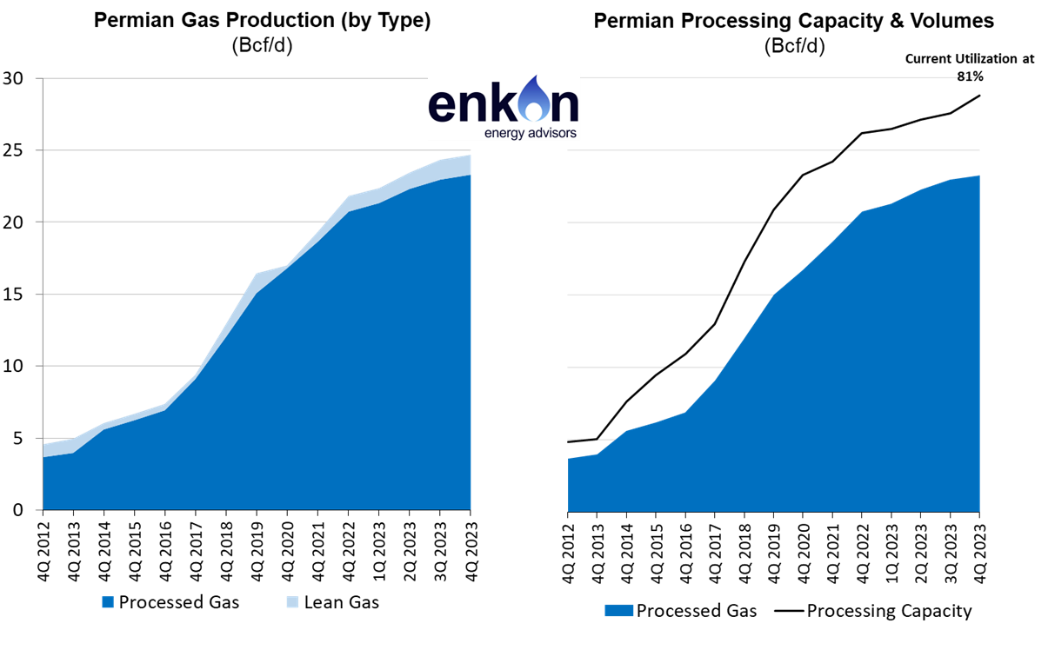
Permian raw gas production, comprising associated gas from crude production and lean gas, has surged from approximately 5 billion cubic feet per day (Bcf/d) in 2012 to around 25 Bcf/d by the end of 2023, marking a compound annual growth rate (CAGR) of 17% over an 11-year period. The Permian region’s abundance of crude oil brings with it a significant amount of wet gas, constituting 95% of the raw gas production. Correspondingly, wet gas production has similarly increased rapidly from around 3 Bcf/d in 2012 to approximately 23 Bcf/d by the end of 2023.
Permian Gas Processing Utilization
To extract NGLs from the residue gas, the burgeoning wet gas production requires processing at numerous gas processing plants scattered throughout the Permian, particularly in the Delaware and Midland sub-basins. In tandem with the rise in wet gas production, these processing plants have undergone expansion and new plants built to accommodate the escalating wet gas volumes. Overall, gas processing plant capacity in the Permian has swelled from roughly 5 Bcf/d in 2012 to about 29 Bcf/d by the end of 2023.
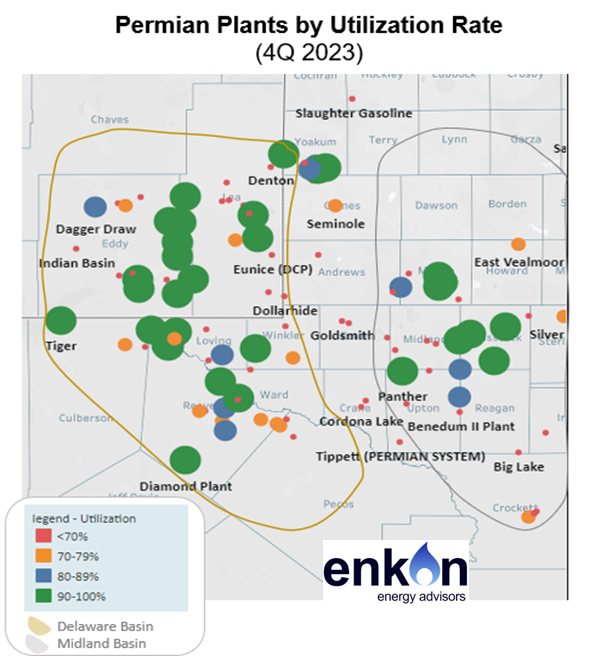
Currently, the Permian region boasts approximately 130 processing plants operated by 25 midstream companies. While the 81% utilization of gas processing capacity offers some reassurance, there are several areas experiencing capacity constraints, with numerous plants operating at or above their nameplate capacity. In the fourth quarter of 2023, for instance, around 45 plants were operating at or near full capacity. Identifying these hotspots with limited spare gas processing capacity is crucial for future infrastructure planning and development. The heat map below highlights the geographical distribution of gas plants based on their utilization factors (green dots indicating highly utilized gas processing plants). As the heat map depicts, many of the fully utilized plants are in the Delaware basin with few areas in the Midland basin that are also at risk. Midstream companies have announced brownfield plant expansions or new plants that will relieve some of these constraints and allow for extraction of NGLs.
Permian NGL Pipeline Take-Away Utilization
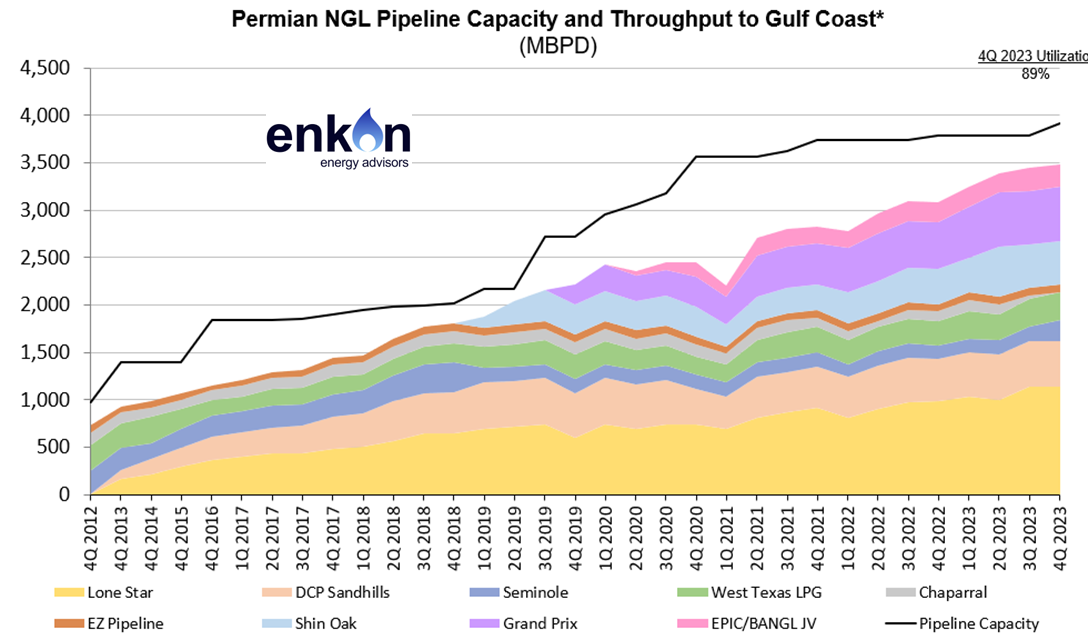
Following the processing of wet gas and extraction of mixed NGLs, downstream transportation of Y-grade NGL becomes pivotal, with potential exposure to pipeline constraints. Understanding pipeline capacity constraints is vital for making informed commercial decisions to safeguard commodity value and producer netbacks. Currently, aggregate NGL pipeline capacity downstream of the Permian basin is operating at 89% utilization, signaling a need for additional capacity to meet growing demand. While pipeline expansions are underway, questions remain about whether these expansions will be sufficient to accommodate anticipated NGL growth. If not, then should NGL marking strategy be realigned with market realities – i.e., reliance on walkup capacity versus securing firm transport and for how long?
Mont Belvieu-Sweeny NGL Fractionation Utilization
Y-grade NGLs from the Permian and other basins are transported to various fractionation locations to be processed into purity NGL products for consumption in end-use markets or exports. While fractionation assets are dispersed across South Texas and Louisiana, the majority of Y-grade NGLs are processed at fractionation hubs in Mont Belvieu and Sweeny, Texas. Utilization rates at these fractionators on aggregate currently hover around 96%, underscoring the urgency of addressing fractionation capacity constraints. How does a producer manage this risk?
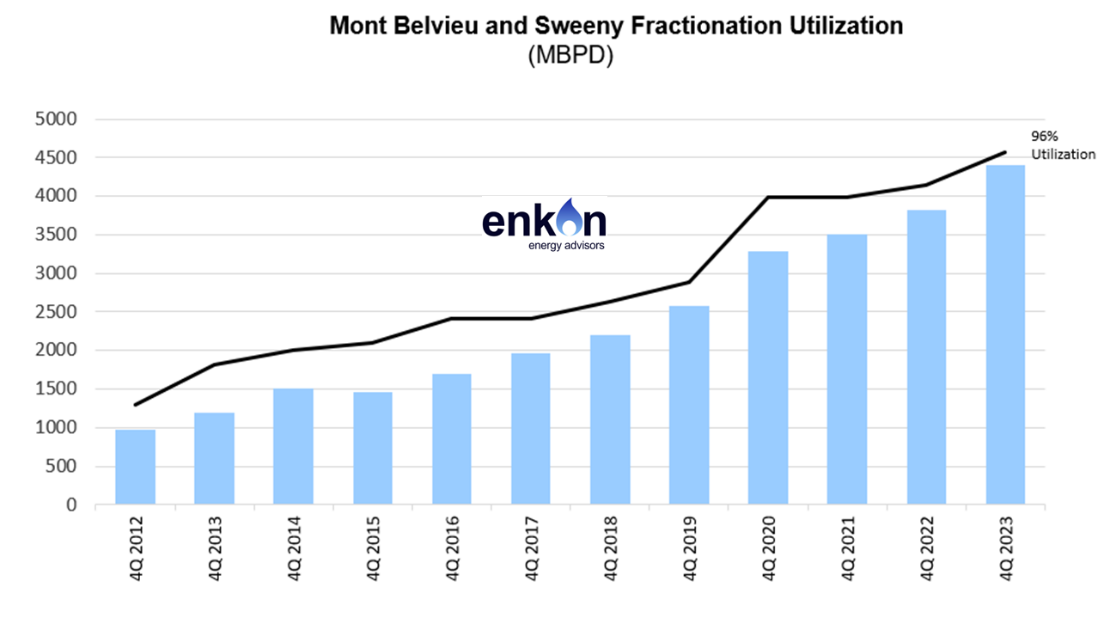
In summary, while the current bottleneck along the NGL value chain may be NGL fractionation capacity, the dynamic nature of the industry means that challenges can quickly shift. Addressing key questions surrounding infrastructure capacity and commercial strategies is essential for mitigating risks and maximizing business value in the face of ongoing growth and change.
- Is there enough capacity in each component of the value chain to protect commodity value? What are the commercial strategies to mitigate this risk?
- How quickly can this landscape change, and how do I keep ahead to maximize business value?
Enkon will be providing a closer look at each of these value chain sectors in upcoming articles. Stay tuned and follow the future chain of articles as Enkon provides a deeper dive addressing many of the questions raised in this article.
-Sue Neville
If you are interested in Permian NGL and Mont Belvieu fractionation outlook and obtaining a detailed analysis on the overall investment risk in this sector, please contact us at info@enkonenergy.com. We encourage you to subscribe to our articles to get weekly articles via email.
Enkon Energy Advisors is a boutique consulting firm specializing in oil & gas, and energy transition since 2012. We bring deep expertise in a range of markets including natural gas, NGLs, Oil, LNG, and Energy Transition where we provide commercial and market advisory to investors, energy companies, and project developers with consulting services, subscription reports, and analytics, with the goal of delivering commercially actionable outcomes to our client.