
The global shipping industry is executing a measured transition in its primary energy mix. LNG bunkering is demonstrating consistent, structural growth. As environmental mandates tighten and commercial fleets modernize, LNG bunkering has changed from a niche alternative into a core pillar of maritime logistics. Projected to experience compounding annual growth through the 2030s, the LNG bunkering market is establishing a resilient long-term valuation trajectory, driven by strict decarbonization frameworks, record dual-fuel vessel orders, and a maturing global supply chain.
Regional Market Trajectory
Historical demand trends reflect a clear, steady upward trajectory across all major shipping regions. Global LNG bunkering volumes have more than tripled since 2021, led by growth in Europe driven by stronger economics and regulatory incentives.
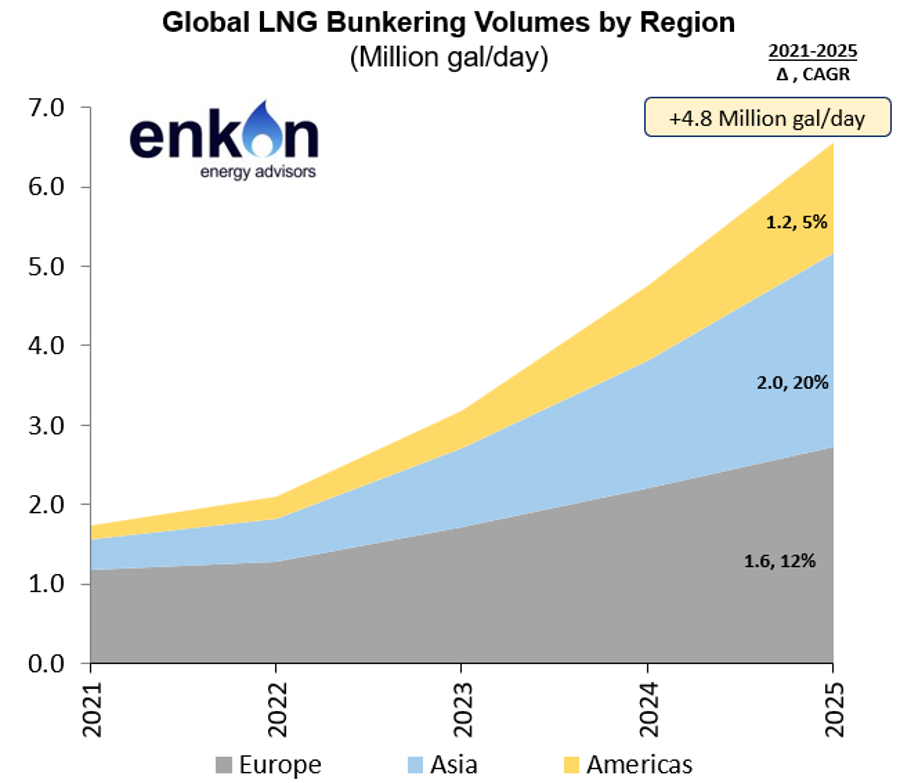
The American market is not as developed as European and Asian LNG Bunkering Markets, but with a low Henry Hub gas price and strong shipping demand there is potential to grow.
Regulatory Catalysts & Fleet Modernization
The primary catalyst behind this development is the intensifying regulatory environment enforced by the International Maritime Organization (IMO) and regional bodies. With the implementation of the IMO’s Carbon Intensity Indicator, alongside the European Union’s Emissions Trading System (EU ETS) and FuelEU Maritime rules, operating polluting vessels has become a direct financial liability. LNG eliminates up to 99% of sulfur oxides and fine particulate matter, cuts nitrogen oxide emissions by up to 85%, and reduces well-to-wake greenhouse gases by nearly 20% compared to traditional marine fuels. To insulate balance sheets against escalating carbon penalties, ocean carriers have initiated a massive fleet transformation. More than a third of new vessel build orders specify dual-fuel LNG capability, concentrated heavily in high-volume container lines and tanker fleets. This capital commitment guarantees sustained, multi-decade demand for cryogenic bunker infrastructure.
Infrastructure Maturation & Supply Scale
The commercial viability of LNG bunkering has unlocked significant scale as major maritime hubs expand specialized transfer assets. Ship-to-Ship (STS) bunkering has emerged as the dominant delivery mechanism, accounting for over 40–60% of market revenues in major hubs such as Singapore, Rotterdam, and along the Florida Coast. Dedicated LNG bunkering vessels (LNGBVs) allow large ocean-going container ships to refuel simultaneously during cargo loading, preserving tight port turnaround times. Beyond operational efficiency, LNG bunkering offers shipowners a unique bridge to net-zero shipping. Existing LNG distribution infrastructure, engine designs, and cryogenic bunkering vessels are fully compatible with drop-in renewable fuels like Bio-LNG (liquefied biomethane) and synthetic e-LNG. This drop-in capability mitigates asset obsolescence risks, giving shipowners a clear, incremental path toward deep decarbonization without requiring completely new propulsion hardware or port retrofits.
Investment Outlook
The macroeconomic fundamentals supporting LNG bunkering remain exceptionally strong. A massive expansion in global liquefaction capacity (particularly from the United States and Qatar) is bringing significant new supply online, stabilizing fuel spreads relative to conventional marine gasoil and far costlier green alternatives like hydrogen. As capital is funneled into bunker barges and storage terminals, LNG bunkering has cemented its standing. It is no longer just a transitionary fuel experiment, but a primary engine of long-term commercial value across the modern maritime supply chain.
Conclusion
The valuation growth of the LNG bunkering market marks a fundamental restructuring of maritime capital deployment. What began as a compliance strategy to satisfy immediate sulfur and emissions standards has matured into the primary commercial pathway for deep maritime decarbonization. Driven by escalating regulatory costs and expanding global liquefaction, LNG bunkering offers shipowners a rare combination of immediate environmental compliance and long-term asset protection. It has cemented its position not merely as a temporary bridge, but as a critical driver of value across the global supply chain for decades to come.
– Siddhant Kulkarni
If you are interested in the U.S. and global LNG Bunkering outlook and a deeper analysis of the implications of the current market environment, please contact us at info@enkonenergy.com. We encourage you to subscribe to our articles to get weekly insights via email.
Enkon Energy Advisors is a boutique consulting firm specializing in oil & gas, and energy transition since 2012. We bring deep expertise in a range of markets including natural gas, NGLs, Oil, LNG, and Energy Transition where we provide commercial and market advisory to investors, energy companies, and project developers with consulting services, subscription reports, and analytics, with the goal of delivering commercially actionable outcomes to our clients.