
Tight U.S. natural gas supply-demand balances have generated renewed interest in natural gas storage assets among end-users, marketers/traders, operators, developers, and the financial community. After almost a decade of lackluster performance for natural gas assets, the midstream community is taking a second look at natural gas storage assets that thrive during periods of market tightness.
Let’s briefly discuss some natural gas history. Pre-2006 was an era of declining U.S. gas production and increasing LNG imports – the U.S. was running out of gas! The resulting tightness in the market supported high natural gas prices and elevated price volatility, important ingredients for supporting healthy valuations of natural gas storage capacity. High volatility and rising seasonal spreads also provided strong signals for a new cycle of investment in high-deliverability gas storage space between 2004-2010. As a result, ~400 Billion cubic feet (Bcf) of greenfield high-deliverability storage capacity was developed just in the USGC (a ~50% increase from 2006 levels).
Post-2010, however, the success of shale gas led to a structural shift in U.S. gas markets. The U.S. no longer needed imports, except in some local northern states, and U.S. gas markets transformed from import dependency to self-sufficiency. Eventually, LNG exports were needed to balance abundant domestic supply. The supply overhang reduced gas prices, flattened forward curves, and compressed seasonal spreads or intrinsic value of storage. The supply overhang and low prices also reduced the intensity of price dislocations, lowering price volatility (or extrinsic value of storage) – all detrimental to gas storage lease rates and valuations. The following graphic charts average lease rates for high-cycle and low-cycle firm storage service (“FSS”) in the U.S. Gulf Coast.
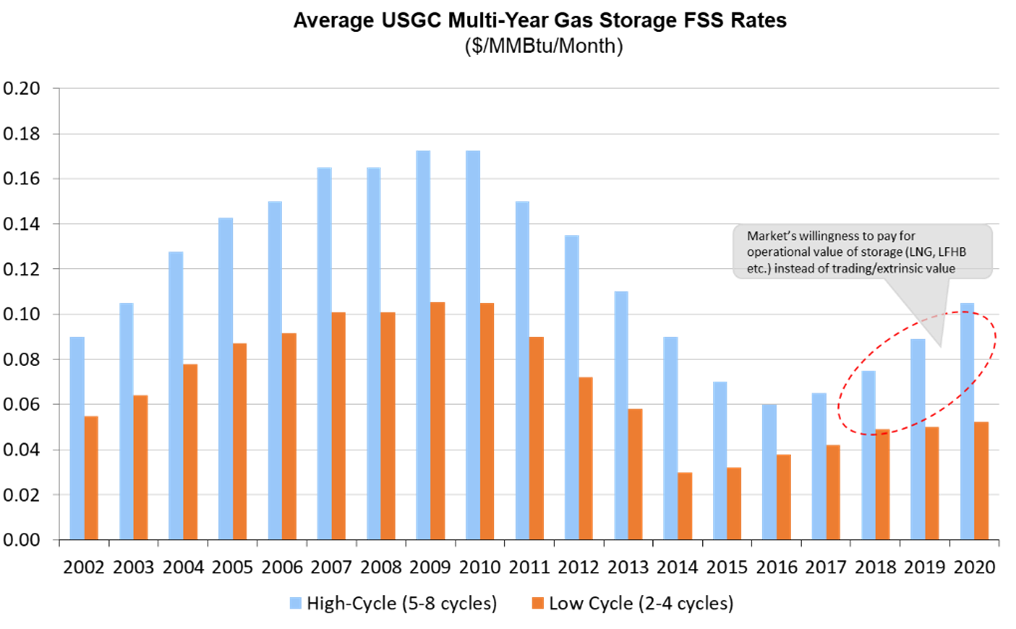
FSS rates fell dramatically, stalling the investment cycle and leading to no natural gas storage capacity additions since 2015 – despite a ~72% increase in USGC gas demand. Due to tight conditions in the current U.S. natural gas market, FSS rates have begun to inch up again, driving significant interest amongst operators, traders, and investors. We believe significant structural changes in U.S. Gulf Coast will eliminate the supply overhang, increase volatility, and support the need for traditional and non-traditional storage services. Key drivers on the demand side include increasing LNG exports, sustained growth in exports to Mexico, and higher penetration of renewable/intermittent sources of power generation (i.e., wind and solar). All this momentum on the demand side is not likely to be matched by the supply side, which will likely not be able to keep pace with growth in demand. These factors would create a gas market resembling the one we experienced at the turn of this century. As USGC gas demand increases to 50 Bcf/d by 2027, FSS rates in USGC would need to increase to support greenfield storage development. At that point of time, we would have turned a complete circle…
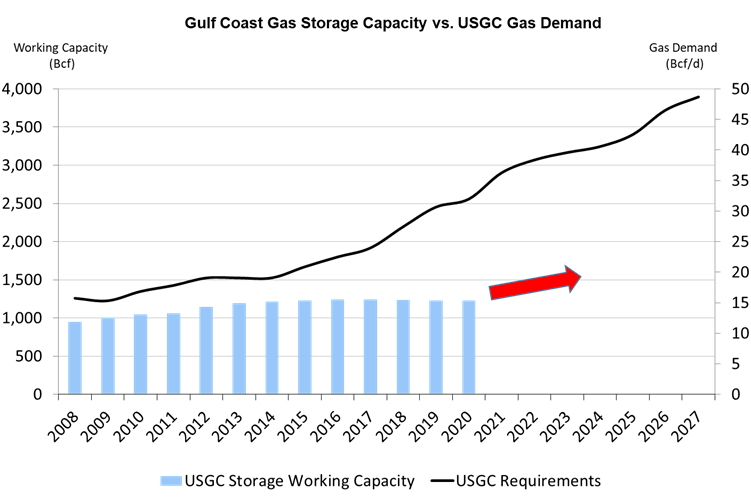
Quantifying the need for storage will always be a difficult proposition. The long-term adequacy of storage capacity is highly dependent on the level of price volatility customers consider “acceptable,” their tolerance for price risk, and how that risk is valued. However, it does appear that the stars may be finally aligning for natural gas storage assets.