
When it comes to pipeline take-away constraints out of the Permian, the spotlight has largely been on natural gas and NGLs. However, Permian crude oil takeaway pipeline situation is not far behind and remains dynamic given the possibility of multiple large offshore crude oil terminals in the U.S. Gulf Coast still in play. Understanding and navigating the complexities of the evolving crude oil takeaway pipeline situation from the Permian Basin is essential for stakeholders across the energy sector to effectively manage risks and capitalize on opportunities in this dynamic environment. This article provides benchmarking of crude oil egress from the Permian and provides perspectives on impact on regional flows due to future large offshore export terminals.
Permian crude oil production lags midstream
By late 2018, pipeline infrastructure to move crude oil out of the Permian basin faced constraints with high-utilization rates reported on several pipelines. This impacted the in-basin crude oil prices and the market responded by adding new pipeline capacity. Between 2019 to 2021, there were five new pipelines commissioned enhancing crude oil transportation capacity out of the basin. Of the five, three pipelines were added targeting the Corpus Christi market including Cactus II, EPIC, and Gray Oak which added ~2.2 MBPD of incremental capacity. Two pipelines added capacity to the Houston refining and export hub which were Midland to Echo III, and Wink-to-Webster with total capacity of ~1.9 MBPD. These capacity additions provided needed relief and marketing options for Permian oil producers.
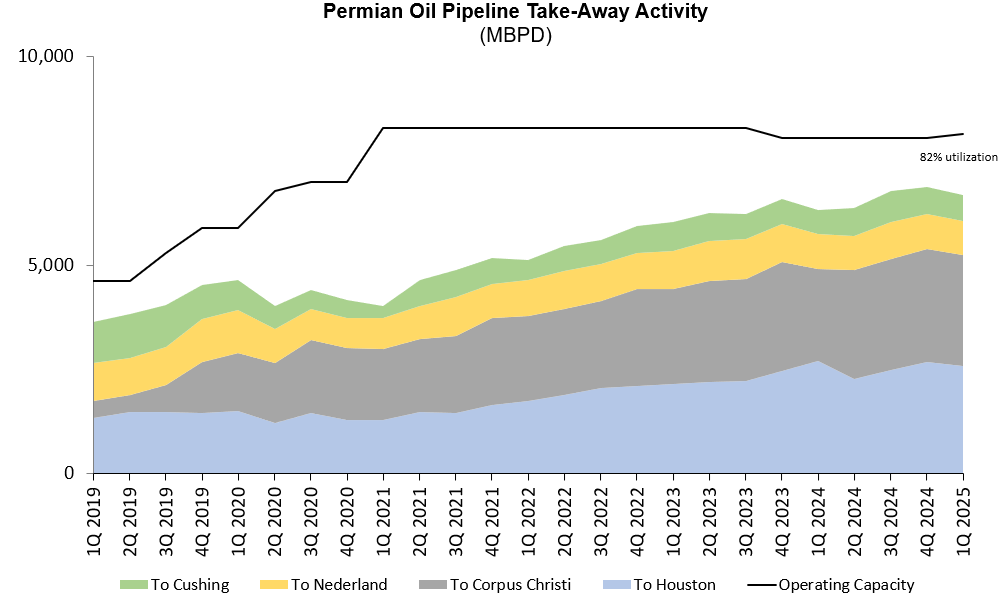
Despite the temporary alleviation of capacity concerns, recent trends indicate a resurgence of take-away capacity challenges. With continued growth in crude oil production in Permian basin, availability of spare capacity has once again reared its head, particularly concerning specific pipeline routes to the gulf coast. In 4Q 2023, the conversion of the ME II pipeline from crude oil to NGL transport by Enterprise reduced oil pipeline capacity to Houston by 225 MBPD. The combination of increased oil volumes and diminished capacity heightens the risk of disruptions in the market, especially in the event of pipeline outages.
Permian Growth Outlook and Incremental Capacity Considerations
Expectation of favorable oil prices will likely continue to add significant crude oil volume out of the Permian. Enkon forecast suggests ~8.3 million bpd of crude oil production from the Permian by the end of 2034. However, factors such as multiple E&P consolidations in the Permian have reduced presence of nimble independent producers which may affect the pace of production growth. Regardless, incremental crude oil barrels would need to move on pipelines predominately to the gulf coast or northbound for storage in the mid-continent market. One of the key considerations for future capacity additions is the impact of future offshore crude oil export terminals (if built) on flow patterns out of the Permian. Since these offshore export terminals can load VLCC (Very Large Crude Carrier) with capacity of 2 Million barrels in a day, they have the scale to impact regional flow dynamics. With Corpus Christi pipelines full, an offshore export terminal sourcing crude from Nederland or Houston will attract spot barrels or barrels that are not yet committed to any expansion project.
Route to Corpus Christi is already constrained
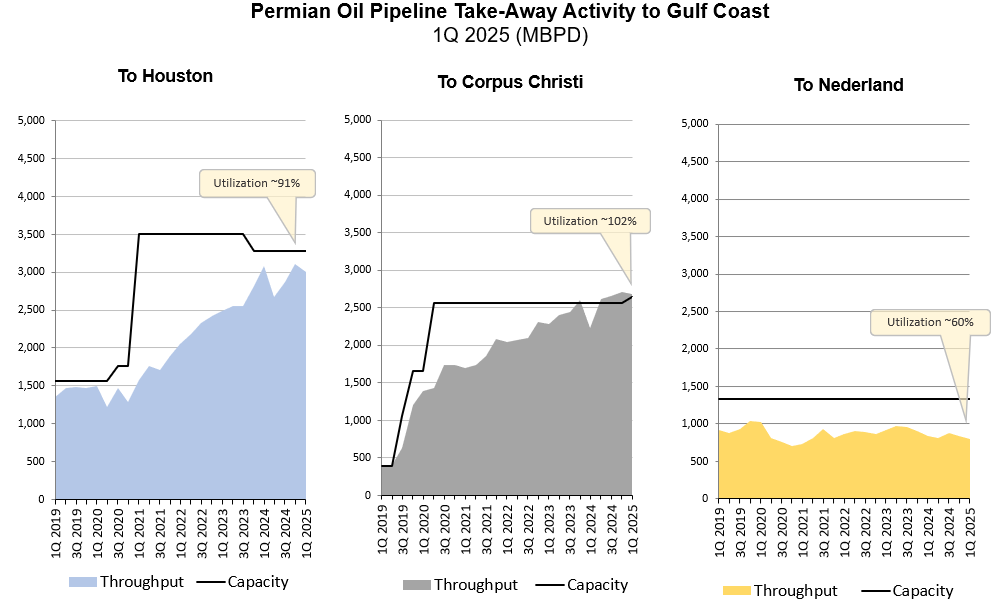
By the end of 4Q 2023, pipelines servicing the Corpus Christi corridor had reached full capacity with Gray Oak surpassing its designed capacity. There are several reasons for attractiveness of Corpus Christi – superior netback economics for producers, less co-mingling of crude grades/better quality oil to export terminals, better marine loading economics, and less marine congestion compared to other ports. In 1Q 2025, the Gray Oak pipeline completed an expansion of 80 MBPD. The pipeline is planning another 40 MBPD expansion, but not until 2Q 2026. Current pipelines may be able to increase capacity by adding horsepower, for example, EPIC crude pipeline can add up to 300 Mb/d capacity if market conditions support proceeding with such an expansion. New greenfield pipeline being built to Corpus Christi may be a riskier proposition. New VLCC-capable offshore export terminals, if sanctioned, can undercut economic advantage of shipping crude to Corpus Christi. The offshore terminal scenario will likely prohibit any new pipelines on this route until it is known if any of these terminals will be built. With the Corpus Christi corridor being full, shippers will have to move to other routes like to Houston or Nederland.
Route to Houston is filling fast
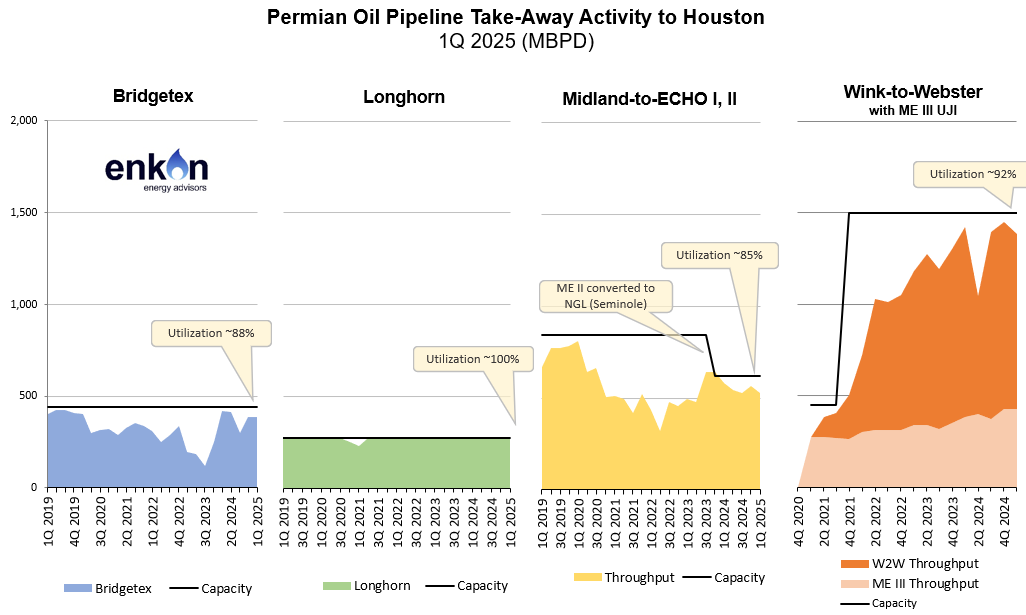
Aggregate utilization of pipeline route to Houston was at 91% in 1Q 2025. Longhorn has been operating near full capacity. For other outlets to Houston, Bridgetex and Midland-to-Echo I, II and Wink-to-Webster have had increasing volumes flirting with utilization nearing capacity. With market signaling the need for more capacity, Enterprise Products is planning on returning the Seminole NGL capacity back to ME II oil capacity the end of 2025 which will add another 225 MBPD of capacity to Houston. Beyond Enterprise conversion, there are no other expansions planned at this time.
Routes to Nederland and Cushing remain underutilized
The route to Nederland was operating at 60% utilization 1Q 2025 with individual pipelines experiencing varying degrees of capacity utilization. West Texas Gulf pipeline was operating at ~99%. For the last year Permian Express has been operating between in the 50% utilization range. While the corridor as a whole seems to possess adequate capacity, operational issues on specific pipelines could pose risks. Pipelines transporting oil north from the Permian Basin to midcontinent markets boast sufficient capacity, barring the exception of P66 WA Line 80 to Borger which fluctuated between 85% and 100% utilization rates this last year. This pipeline corridor, although less economical, also presents an alternative for shippers aiming to access the Gulf Coast when direct routes from the Permian Basin are not feasible for their volume requirements.
Commercial Implications
In summary, while there are plans for expansion and conversion to address some of the capacity issues, multiple individual pipelines within the corridors to the Gulf Coast are currently at full capacity. This presents individual pipeline risk that needs to be managed effectively. A big unknown that will impact pipeline additions out of Permian will be the potential for commercialization of VLCC capable offshore export terminals. Key questions remain:
- Will any of these be approved and built? If so, how much capacity and when?
- What affect will offshore export terminals have on Permian flow dynamics?
- Which regions in the US Gulf Coast will attract Permian barrels?
-Sue Neville
If you are interested in Permian crude oil outlook and obtaining a detailed analysis on the overall investment risk in this sector, please contact us at info@enkonenergy.com. We encourage you to subscribe to our articles to get weekly articles via email.
Enkon Energy Advisors is a boutique consulting firm specializing in oil & gas, and energy transition since 2012. We bring deep expertise in a range of markets including natural gas, NGLs, Oil, LNG, and Energy Transition where we provide commercial and market advisory to investors, energy companies, and project developers with consulting services, subscription reports, and analytics, with the goal of delivering commercially actionable outcomes to our client.