An in-depth analysis of Bakken NGL infrastructure reveals a complex landscape of growth, take-away limitations, and rapidly evolving competitive landscape. While crude oil production currently stands at approximately 1.3 million barrels per day (BPD)—still below pre-COVID peaks—natural gas output with high natural gas liquids NGLs content has surged to nearly 3.5 billion cubic feet per day (Bcf/d), driven by a rising Gas to Oil Ratio (GOR) that has increased from 1.0 in 2008 to ~3.0 in 2024. Recent developments, such as Kinder Morgan’s decision to convert its Double H Pipeline system from crude oil to NGL service, reflect the shifting competitive dynamics within the region. Kinder’s Double H project will be in direct competition with ONEOK which exclusively controls southbound NGL outlet out of the Bakken. It appears that Kinder’s project will enhance overall competitiveness of Bakken NGLs.
Bakken NGL Infrastructure Overview
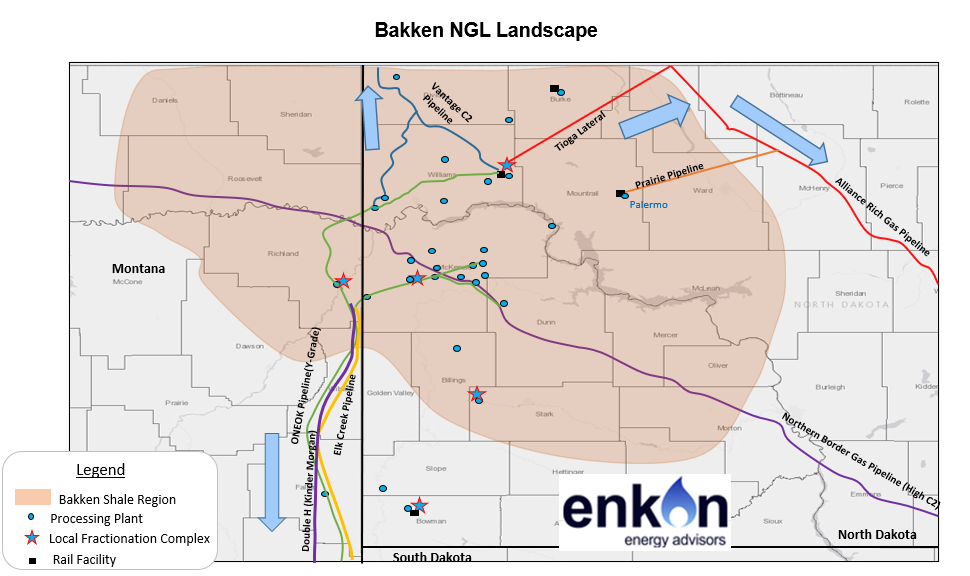
The light, sweet crude produced in the Bakken has historically fueled the region’s economic engine. However, this oil-rich play also yields significant volumes of wet gas, requiring extensive processing. Currently, the Bakken boasts around 30 gas processing plants, extracting approximately 450,000 barrels per day of NGLs, with the potential to scale up to ~700 MBPD under optimal market conditions. The NGLs are transported out of Bakken via several outlets, including the Vantage ethane Pipeline, ONEOK Bakken Pipeline (Y-grade), Elk Creek Pipeline (Y-grade), Alliance Pipeline (wet-gas), and via rail/truck.
Despite these extensive facilities, the Bakken faces significant challenges, particularly with ethane, a crucial component of NGLs. While approximately 100 MBPD of ethane is successfully extracted, ~ 270 MBPD is rejected back into the gas stream. This rejection is largely due to unfavorable market conditions for ethane and pipeline constraints, which limit the transport of ethane to key markets in the Midcontinent and further downstream to Mont Belvieu, Texas. The continued rejection of ethane poses operational risks for region’s natural gas pipelines where ethane’s higher heat content can disrupt natural gas operations. As high ethane content in the gas stream becomes an issue for downstream gas customers located in the Midwest, Bakken producers may be compelled to extract more ethane, highlighting the urgent need for additional southbound NGL takeaway capacity from the basin as depicted below.
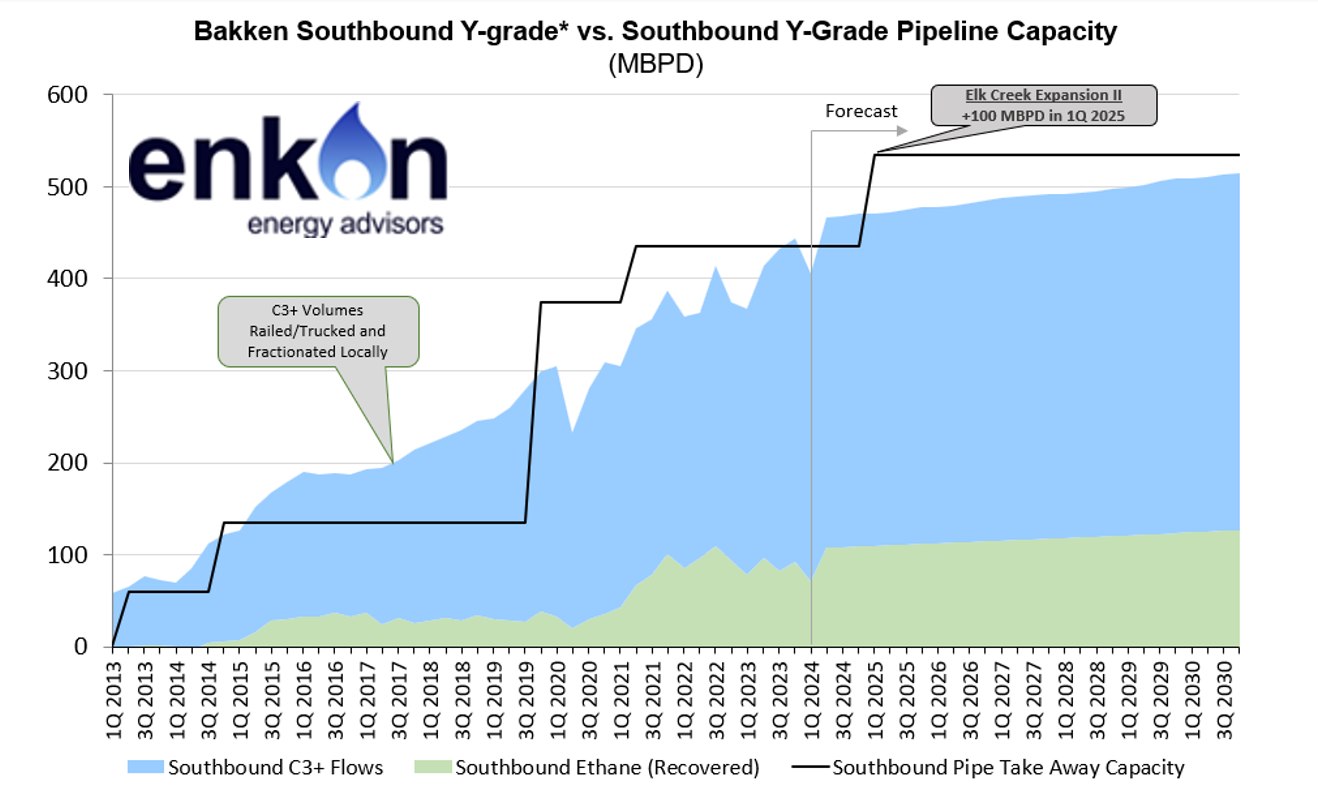
Two significant projects are poised to address these challenges. ONEOK’s expansion of the Elk Creek Pipeline will add 100 MBPD of capacity in 2025, while Kinder Morgan’s conversion of the Double H Pipeline is expected to add more Southbound NGL capacity. Running parallel to ONEOK’s pipeline down to Guernsey, WY, the Double H Pipeline will alleviate current constraints in NGL takeaway capacity. However, as the Double H Pipeline transitions from crude oil service to NGL service, it will impact crude oil takeaway capacity—a topic that warrants further exploration and will be discussed in a future article.
Upon completion of Elk Creek Expansion and Double H conversion, NGL take-away issues from the Bakken will likely be resolved for foreseeable future. Double H may also assist with creating more space on natural gas pipelines by accommodating incremental ethane extraction. All of this bodes well for crude oil production from the Bakken which has struggled to go past Pre-covid levels in part due to lack of adequate take-away options.
Conclusion
While the conversion of Double H pipeline from crude oil to NGLs is not a game changer for Bakken producers, it does provide Bakken producers and NGL shippers with a southbound pipeline alternative to ONEOK. The upcoming pipeline expansions signal a proactive approach to addressing the region’s growing needs. As the Bakken region navigates take-away challenges, the ability to balance growth with take-away capacity across hydrocarbons will determine its future success.
-Kush Thakkar
If you are interested in our Bakken NGL benchmarking and outlook and obtaining a detailed analysis on hydrocarbon take-away from the Bakken, please contact us at info@enkonenergy.com. We encourage you to subscribe to our articles to get weekly articles via email.
Enkon Energy Advisors is a boutique consulting firm specializing in oil & gas, and energy transition since 2012. We bring deep expertise in a range of markets including natural gas, NGLs, Oil, LNG, and Energy Transition where we provide commercial and market advisory to investors, energy companies, and project developers with consulting services, subscription reports, and analytics, with the goal of delivering commercially actionable outcomes to our client.