
As discussed in our previous article, Crude-by-Rail in Western Canada is currently undergoing a significant transition following the completion of the Transmountain Pipeline Expansion (“TMX”), earlier this year, which temporarily eased pipeline constraints for crude producers. However, this relief is projected to be short-lived, as supply is expected to surpass pipeline capacity by 2027 due to increased production and the absence of further significant expansions to crude takeaway pipelines. This excess supply (post 2027) will need to be transported primarily by rail out of the region.
Role of DRU
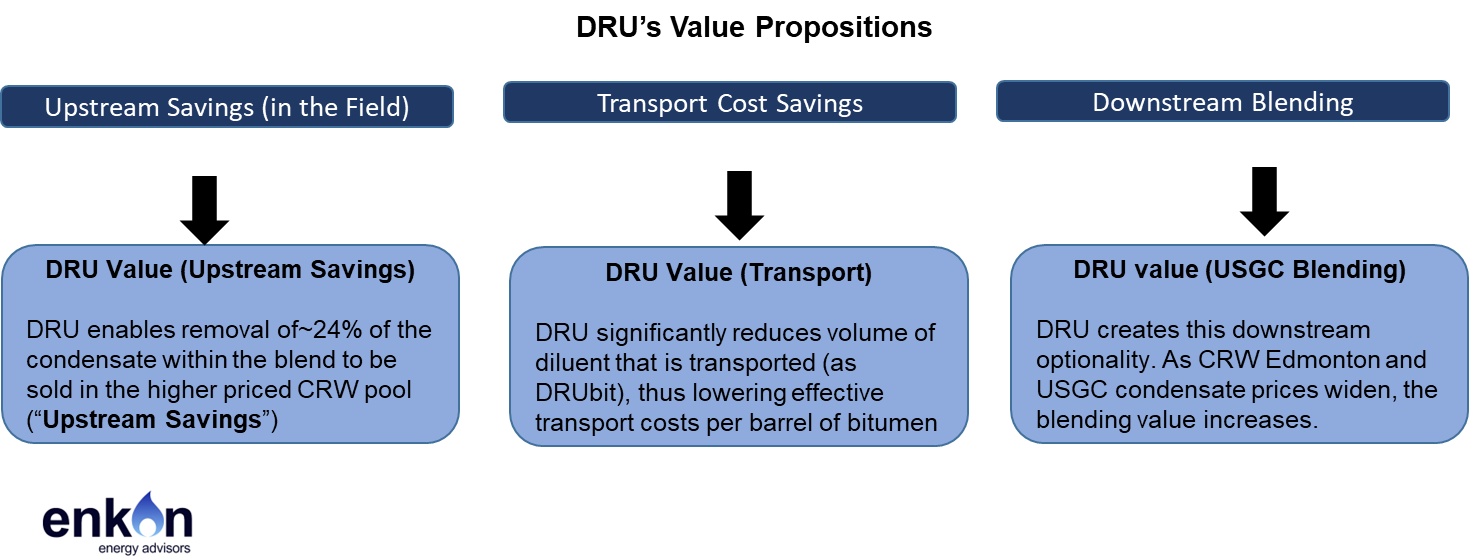
Western Canada boasts a variety of rail terminals, predominantly in Alberta, with a collective rail takeaway capacity of 1.3 million barrels per day (BPD). Key terminals include Pembina in Edmonton and USD Partners’ Hardisty Terminal. Notably, the Hardisty Terminal features a Diluent Recovery Unit (DRU), providing significant advantages for Western Canadian bitumen producers across the value chain. Unlike dilbit (a 70% bitumen, 30% diluent blend) transported via pipeline, DRUbit significantly reduces the diluent content to around 8% (24% removed from original composition), thereby enhancing economic efficiency for producers utilizing this facility. As rail transport becomes increasingly relevant starting in 2027, the ability to transport bitumen while minimizing diluent penalties will be a key differentiator. The DRU offers substantial uplift to producer netbacks and, in some cases, can compete favorably with marginal pipeline options. In this article, we will explore the various value drivers that the DRU offers to producers. The value drivers are the savings afforded in the field or upstream savings, saving on the cost to transport, and downstream blending opportunities in the U.S. Gulf Coast.
Upstream Savings
When moving bitumen via pipeline from the field to Hardisty, producers currently purchase condensate at a higher price index (CRW) and sell their diluent as part of the dilbit at the lower WCS index price. However, with the DRU, producers can recover approximately 24% of the higher-value condensate, which can then be returned to the higher-priced CRW pool. For example, with a CRW Pool Price of $70 per barrel, a WCS Hardisty Price of $55 per barrel, and a DRU Fee of $12 per barrel of condensate, producers can achieve savings of approximately $0.65 per barrel of bitumen. This provides a valuable retention of revenue for producers.
Transport Cost Savings
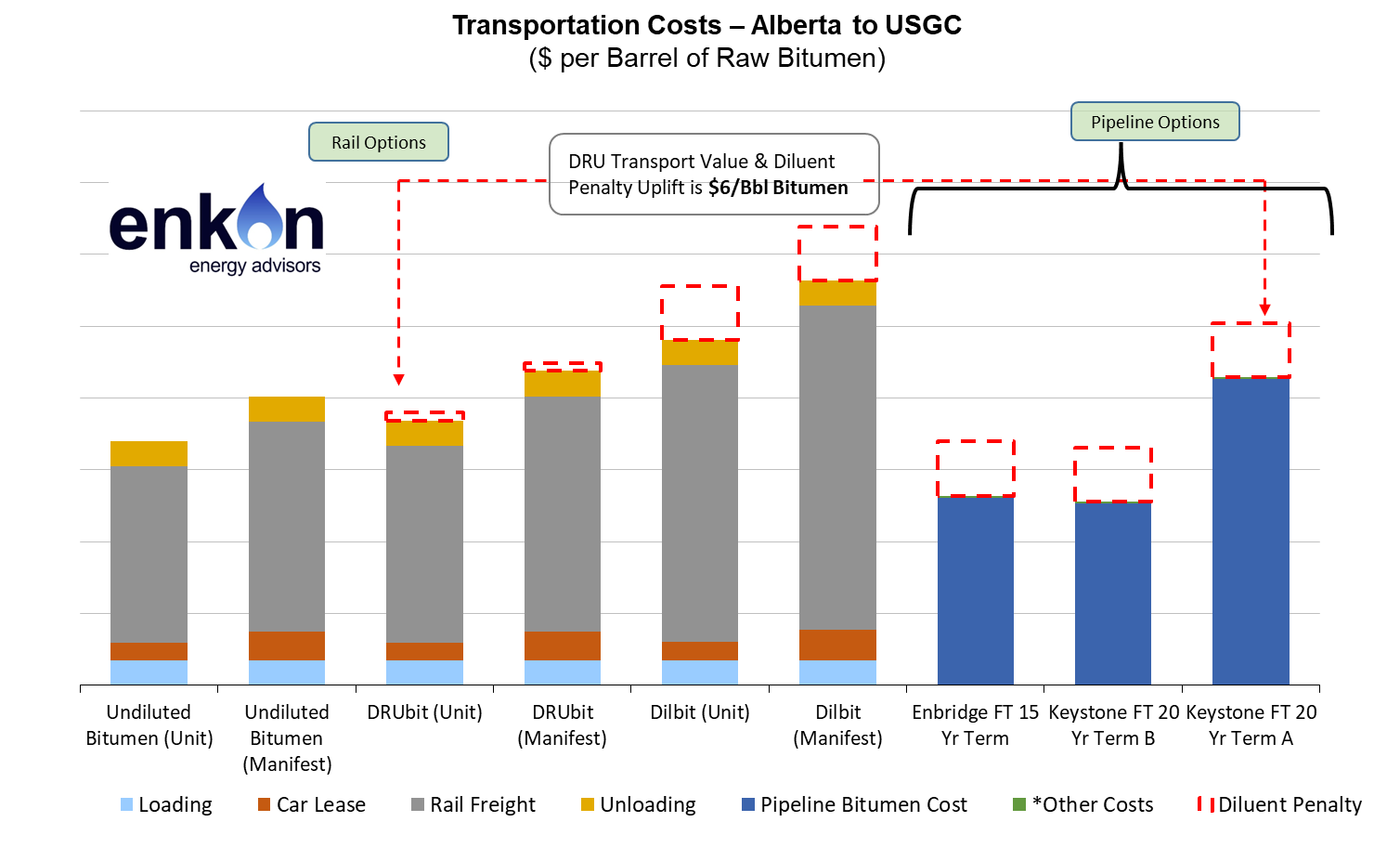
Typically, a 70% bitumen-30% diluent blend is transported via pipeline to the U.S, meaning that 70% of the bitumen bears 100% of the pipeline tariff (“Cost of Diluent Transport”). Additionally, since diluent is purchased at a higher price in Canada and sold at a lower price in the USGC, a dilbit barrel incurs a “Diluent Penalty.” The DRU significantly reduces the volume of diluent that is transported, allowing DRUbit to lower transportation costs per barrel of bitumen. Additionally, DRUbit enjoys lower rail freight costs compared to dilbit. Overall, the total transportation costs for DRUbit are closer to the costs of pipeline transport than the higher costs associated with transporting dilbit by rail.
Downstream Blending
Once DRUbit reaches the USGC, it must be blended before it can be marketed. For example, if the bitumen is to be transported via pipeline to a market, it will need to be blended back into a dilbit. The 24% of condensate removed during processing will need to be reinserted, but at a lower cost per barrel of condensate than in Western Canada. In simple terms, producers can “recreate dilbit” but at a significantly reduced cost.
This is not the only downstream value opportunity the DRU provides. Canadian producers also benefit from increased optionality, allowing them to create higher-value custom blends. For example, a producer seeking to create a custom blend priced at $80 per barrel in the USGC – while NYMEX WTI is priced at $74 per barrel, WCS Houston is priced at $67 per barrel, and USGC condensate is priced at $61 per barrel – would achieve a $3 per barrel uplift using DRUbit. This is due to the ability to sell the bitumen at a higher price than the WCS Houston price by utilizing DRUbit in the custom blend.
Conclusion
The DRU at USD Hardisty offers multiple opportunities for bitumen producers in Western Canada to enhance margins and netbacks. Our forecast, based on projected value drivers from 2024 to 2033, suggests that transporting DRUbit by rail is highly competitive, if not more economical, than the pipeline options currently available to Western Canadian producers. This advantage will be amplified when pipeline capacity again becomes an issue in Western Canada.
-Connor Pence
If you are interested in Western Canadian Crude outlook and obtaining a detailed analysis of Western Canadian Crude-by-Rail, please contact us at info@enkonenergy.com. We encourage you to subscribe to our articles to get weekly articles via email.
Enkon Energy Advisors is a boutique consulting firm specializing in oil & gas, and energy transition since 2012. We bring deep expertise in a range of markets including natural gas, NGLs, Oil, LNG, and Energy Transition where we provide commercial and market advisory to investors, energy companies, and project developers with consulting services, subscription reports, and analytics, with the goal of delivering commercially actionable outcomes to our client.