The Western Canadian oil sands industry is undergoing a significant transformation. Favorable economics, improved producer netbacks and improved market access are all conducive for an upswing in crude oil production from Western Canada driven primarily by growing production from oil sands in Alberta. Historically, constrained crude take-away pipeline capacity has resulted in heavily discounted crude oil prices in Western Canada impacting production growth in the region. Consequently, crude oil producers have relied on Crude-by-Rail (CBR) to ensure adequate market access. The recently completed 540 MBPD Transmountain Expansion (TMX) pipeline is significant for the region as it provides much needed incremental capacity, bolstering the outlook for crude oil growth from Western Canada.
Relevance of TMX
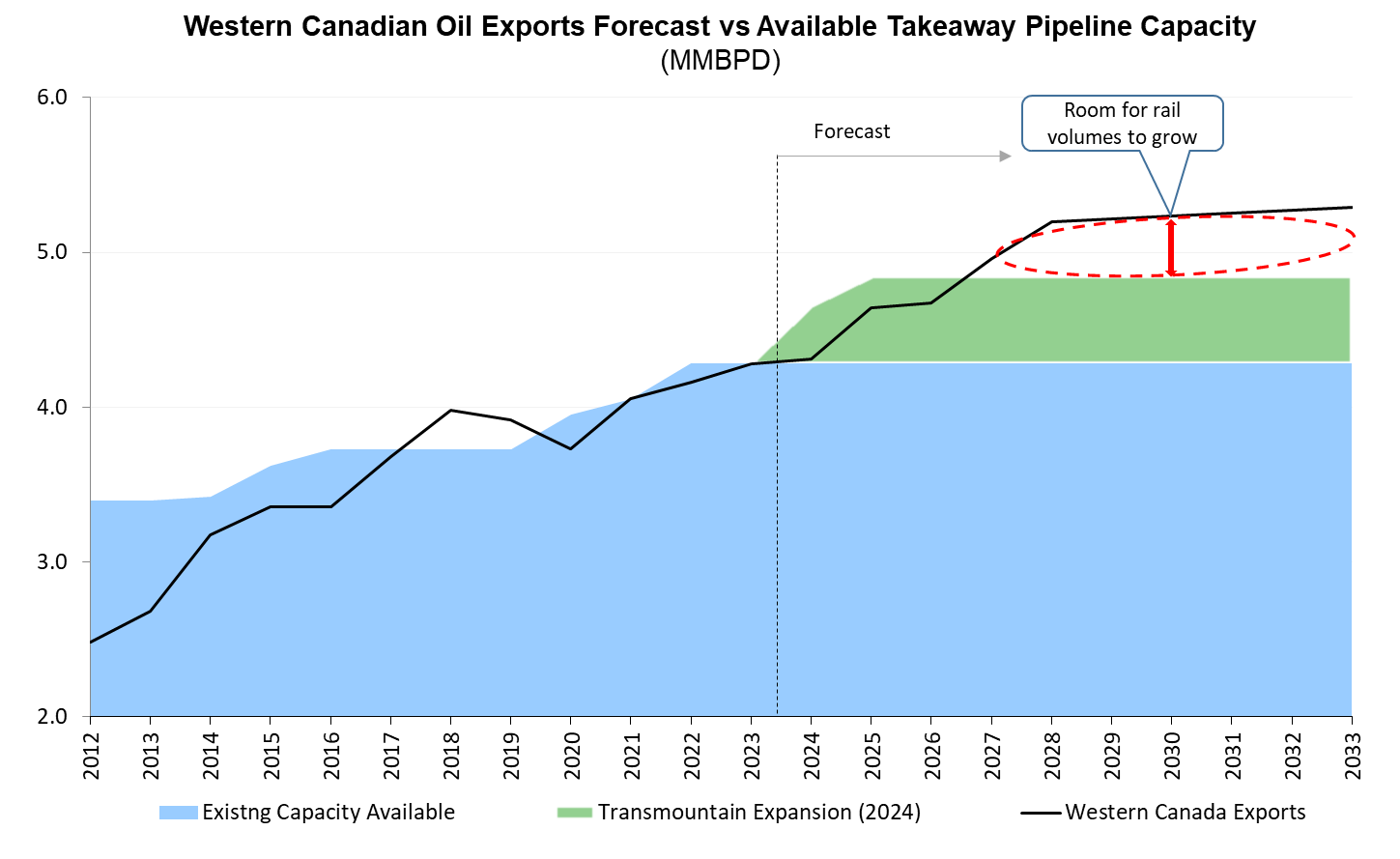
TMX has temporarily eased pipeline takeaway capacity constraints from Western Canada, potentially improving netbacks for benchmark crude Western Canadian Select (WCS). However, our fundamental analysis indicates challenges ahead as crude oil production is set to increase. Multiple oil sands projects (both greenfield and brownfield) are under various stages of development that are expected to increase production of raw bitumen by ~0.6 MBPD. Resultant crude oil supply in Western Canada (including growth in conventional oil/condensate and after bitumen upgrades, dilbit volume gross-up) is expected to increase from 5 Million BPD in 2023 to ~6 Million BPD by 2033. After netting out local refinery demand in Western Canada, crude oil available for exports from W. Canada is expected to increase to 5.0 Million BPD by 2027, surpassing current pipeline capacity (including TMX).
Based on our analysis, current crude-by-rail volumes are contracted at approximately 80 MBPD, which is expected to continue despite TMX. On the other hand, incremental spot CBR volumes are expected to remain low until 2026/2027 due to ample pipeline capacity post-TMX completion. However, with continued production growth and no new pipeline capacity additions on the horizon, spot rail volumes are expected to become significant post-2027.
WCS Pricing & Diluent Recovery Unit (DRU) Value Proposition
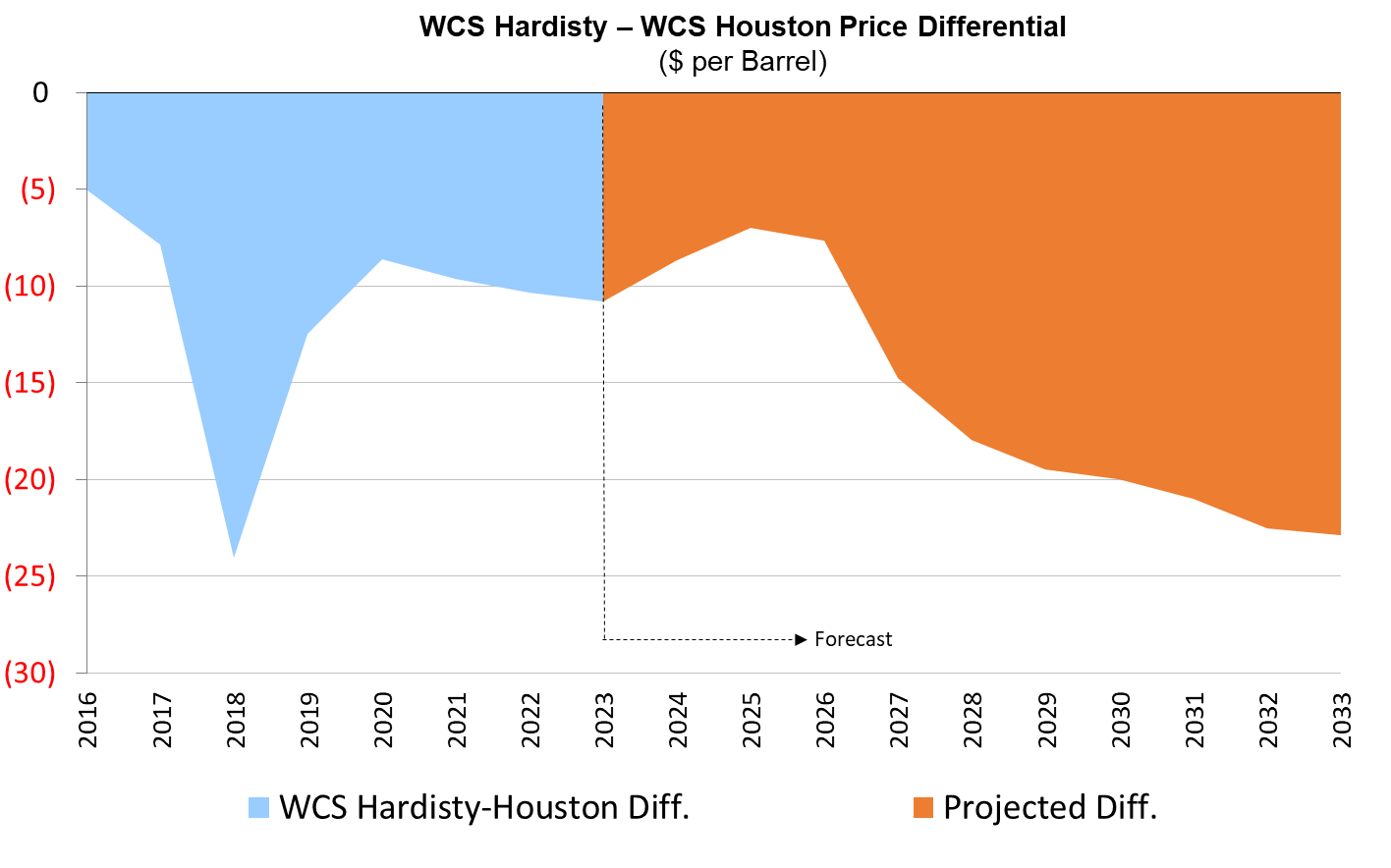
With pipeline take-away constraints anticipated starting 2027, WCS (Edmonton) – WCS (Houston) price differential is expected to widen to levels seen in the past. This situation underscores the urgency for producers transporting crude via rail to find strategies that mitigate negative impacts on their netbacks.
Western Canada boasts a variety of rail terminals, predominantly in Alberta, with a collective rail takeaway capacity of 1.3 Million BPD. Key terminals include Pembina in Edmonton and USD Partner’s Hardisty Terminal. Notably, the Hardisty Terminal features a Diluent Recovery Unit (DRU), providing a multi-faceted value proposition for Western Canadian bitumen producers along the value chain. Unlike dilbit (30% diluent, 70% bitumen) transported via pipeline, DRUbit significantly reduces diluent content to around 8%, thereby enhancing economic efficiency for producers using this facility. As rail becomes relevant again starting 2027, ability to transport bitumen while incurring minimal diluent penalties will be a key differentiator. DRU can provide significant uplift to the producer netback and in some cases compete favorably with marginal pipeline options.
Specific value drivers for DRU for Western Canadian oil sands producers will be explored in subsequent article.
Conclusion
In summary, as Western Canadian crude production expands beyond available pipeline capacity, crude by rail, particularly via terminals equipped with advanced facilities like Hardisty’s DRU, will play a crucial role in managing logistics and optimizing economic returns amidst widening WCS differentials.
-Connor Pence
If you are interested in Western Canadian Crude outlook and obtaining a detailed analysis of Western Canadian Crude-by-Rail, please contact us at info@enkonenergy.com. We encourage you to subscribe to our articles to get weekly articles via email.
Enkon Energy Advisors is a boutique consulting firm specializing in oil & gas, and energy transition since 2012. We bring deep expertise in a range of markets including natural gas, NGLs, Oil, LNG, and Energy Transition where we provide commercial and market advisory to investors, energy companies, and project developers with consulting services, subscription reports, and analytics, with the goal of delivering commercially actionable outcomes to our client.