
The conversation around AI and energy often focuses on data center buildout and grid strain. Less discussed is what sits behind that grid. In Texas and Louisiana, the answer is increasingly natural gas. The AI-driven power surge is not just an infrastructure story. It is a gas demand story, and the scale is large enough to reshape supply and commercial dynamics across the U.S. Gulf Coast over the next decade.
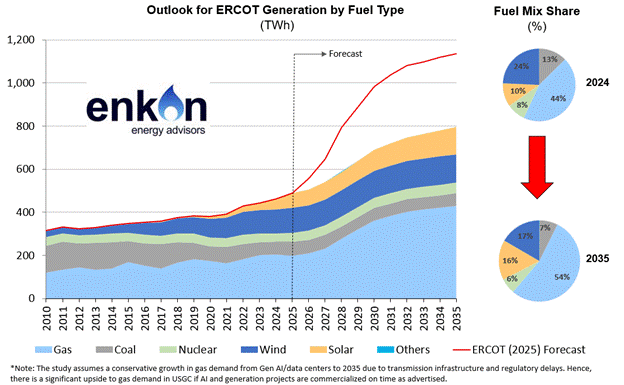
In 2024, natural gas accounted for 44% of ERCOT’s power generation mix, the largest share of any fuel source on the Texas grid. Wind provided 24%, nuclear 13%, and coal 10%. Solar, despite rapid capacity additions, contributed 8%. By 2035, gas is expected to account for approximately 54% of ERCOT’s generation mix, even as other sources continue to grow in absolute terms. Total demand is increasing fast enough that gas must grow alongside it as the most scalable and reliable resource available to meet load around the clock. That distinction matters because even though other sources add capacity, they do not provide the firm, on-demand generation that data centers require. These facilities operate continuously, with little tolerance for interruption. Gas fills that role. It is the reliability layer of a grid increasingly shaped by persistent, high-load demand.
Data Centers Are Driving a Structural Shift in Gas Demand
ERCOT has received over 233 GW of large-load interconnection requests, more than 70% of which is attributed to data centers. This reflects an increase of nearly 300% in 2025 alone. While not all of these projects will materialize, even a fraction represents a step-change in electricity demand. The U.S. Energy Information Administration (EIA) expects ERCOT load growth to average approximately 10% annually between 2025 and 2027. In a high-demand scenario driven by data center growth, load could reach approximately 15% annually.
ERCOT operates largely independently from the wider U.S. grid, meaning demand growth must be met primarily by in-state generation. In Texas, that generation is predominantly gas. The scale of this demand is already becoming tangible. Stargate’s AI infrastructure campus in Abilene alone is projected at 1.2 GW of capacity. Apple, Google, and a growing number of large-scale cloud operators have active or planned facilities in the state. At the same time, behind-the-meter configurations, where data centers contract directly with gas-fired generation, are becoming increasingly common, reflecting the need for reliability and control over power supply.
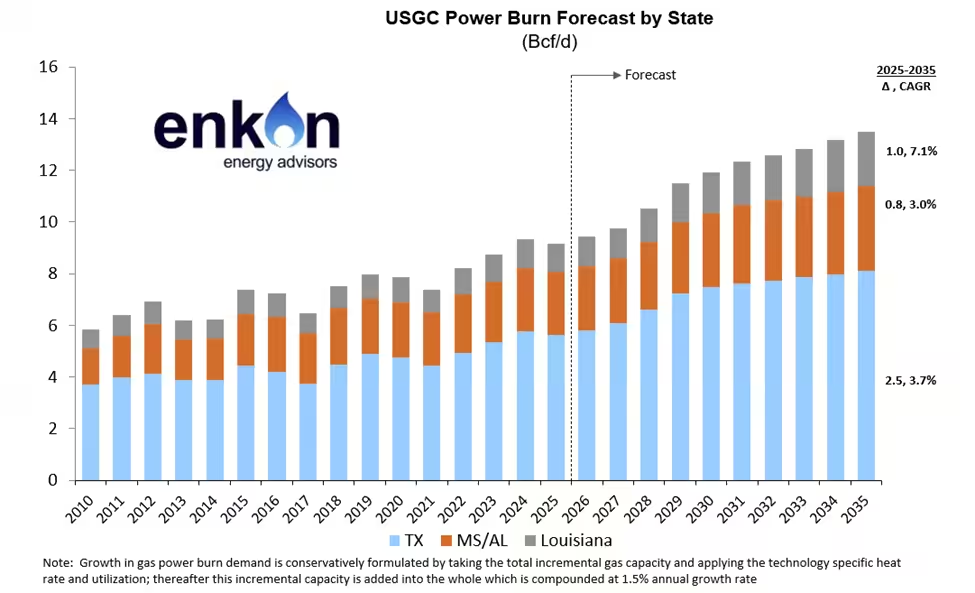
The demand growth story extends beyond ERCOT to the broader U.S. Gulf Coast, including Mississippi, Alabama, and Louisiana, where gas consumption in the power sector is projected to reach about 13.5 Bcf/d by 2035, an increase of 4.3 Bcf/d from 2025 levels.
The broader trend is clear. The commercial detail of how that demand materializes, by location, timing, and counterparty, is where the real analytical work lies. For gas producers, midstream operators, utilities, and industrial players, understanding where and how this demand develops is critical to making sound investment and commercial decisions.
Implications for Gas Supply and Commercial Planning
New gas-fired generation serving data centers requires reliable, long-term fuel supply. How that supply is secured depends on how power is delivered. Direct supply relies on dedicated gas agreements, while grid-based supply depends on pipeline and storage infrastructure to deliver gas reliably to the relevant delivery points.
These models reflect different approaches to meeting rising demand, each with distinct commercial and logistical implications that vary by location, timing, and counterparty. Key considerations include the availability of credible gas suppliers, pipeline capacity and deliverability at relevant hubs, expected pricing and basis dynamics, and the commercial structures emerging between gas suppliers and data center operators. As data center demand continues to scale, these factors will play an increasingly key role in how projects are structured and executed.
Conclusion
Natural gas is not being looked at as a “bridge fuel”. It is being pulled forward by a demand surge that no other resource can absorb at scale. For companies operating at the intersection of gas supply and power demand, this creates both a significant commercial opportunity and a more complex market to navigate.
– Rhoda Kolapo
If you are evaluating gas supply and power solutions for large-scale demand, please contact us at info@enkonenergy.com. We encourage you to subscribe to our articles to get weekly articles via email.
Enkon Energy Advisors is a boutique consulting firm specializing in oil & gas, and energy transition since 2012. We bring deep expertise in a range of markets including natural gas, NGLs, Oil, LNG, and Energy Transition where we provide commercial and market advisory to investors, energy companies, and project developers with consulting services, subscription reports, and analytics, with the goal of delivering commercially actionable outcomes to our clients.