
Chokepoint disruptions, cargo bidding wars, and crude above $100. The old valuation models weren’t built for this — and deals priced on pre-2022 assumptions are already looking expensive.
The LNG market has always been geopolitically sensitive. But what we’re navigating now is categorically different from the supply shocks of prior decades. We are operating in a fragmented, multipolar energy market where trade flows are being redrawn in real time — and where the commercial value of an LNG asset is inseparable from its geopolitical positioning.
For anyone currently running M&A processes or equity investment decisions in this space, the central challenge is this: how do you accurately model and value the flexibility of a global LNG platform when the geopolitical volatility is not a tail risk to be stress-tested, but a base-case condition to be priced in?
“Flexibility is no longer a premium feature of an LNG asset. In a multipolar market, it is the asset.”
Trade flow fragmentation is structural, not cyclical
The disruptions we’re seeing — Strait of Hormuz pressure, Red Sea rerouting, constrained Panama Canal transits — are not episodic. They reflect a structural fragmentation of the global energy trade architecture that has been building for years and is now accelerating.
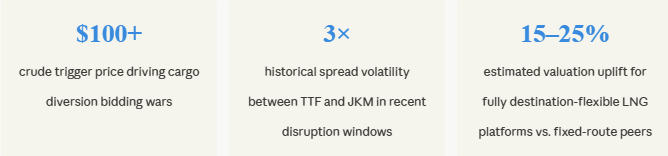
The consequence for LNG specifically is that the arbitrage between Atlantic and Pacific Basin pricing has become both more volatile and more commercially significant. When European buyers are competing with North Asian utilities for diverted cargoes, the spread between TTF and JKM can move in ways that fundamentally alter the economics of a long-term offtake agreement signed three years ago. The LNG assets that can pivot — adjusting destination flexibly, optimizing cargo routing, and capturing spot premiums — are worth materially more than those locked into rigid bilateral structures.
That flexibility premium is real, it’s large, and most DCF models in current deal processes are not capturing it adequately.
Where current valuation models are falling short
I’ve reviewed a number of deal models in the past 18 months. The honest assessment is that most of them are underpricing geopolitical optionality and overweighting contractual stability as a proxy for value protection.
Long-term offtake contracts do provide revenue visibility. But in a world where a buyer’s own regulatory environment, import infrastructure, or sovereign relationship with a supplier country can shift materially within the contract term, counterparty credit and contract structure need to be assessed through a geopolitical lens, not just a financial one. A 20-year SPA with a buyer in a jurisdiction facing energy policy reversal or sanctions exposure is not the same instrument it was five years ago.
Equally, the supply chain vulnerability analysis in most models is still modeled as point-in-time scenario analysis. It needs to become dynamic — continuously updated as chokepoint risk, shipping cost, and destination market pricing evolve. Static stress tests run at deal signing are stale within months in the current environment.
What rigorous LNG due diligence now requires
- Geopolitical scenario modeling integrated into base-case cash flows — not isolated in a sensitivity table
- Destination flexibility valuation: quantify the option value of cargo rerouting rights across Pacific and Atlantic basin premiums
- Dynamic supply chain risk assessment covering Hormuz, Red Sea, Panama, and Malacca simultaneously
- Counterparty geopolitical exposure review — buyer jurisdiction risk, sovereign relationship mapping, sanctions screening
- Liquefaction asset positioning: proximity to multiple export corridors and redundancy in offtake routing
Why platform scale and location still matter enormously
Not all LNG assets are equally positioned for this environment. The large integrated platforms — Gorgon and Pluto on the Australian Northwest Shelf, LNG Canada on the Pacific — have structural advantages that go beyond nameplate capacity. Their proximity to Asian demand centers, combined with established multi-buyer offtake structures and operational track records through prior volatility cycles, make them more defensible in a geopolitically fragmented market than greenfield projects with single-destination exposure.
But even for these assets, the valuation question is increasingly about what proportion of output sits in flexible, market-priced arrangements versus legacy fixed-destination contracts, and what the realistic timeline is for rolling legacy structures into more commercially agile terms. That transition timeline is now a material input to equity valuation — not a footnote.
“The deals being done today will be stress-tested by geopolitical events we cannot fully anticipate. The only honest response is to build that uncertainty structurally into the model — not assume it away.”
The energy executives and investors getting this right are the ones treating geopolitical analysis not as a qualitative overlay, but as a quantitative input with as much rigor as reservoir engineering or shipping cost modeling. It requires different skills, different data, and a different organizational posture in the deal team. But it’s not optional anymore.
I’d welcome the conversation — particularly with those who are actively working through these valuation challenges in live transactions. The more the industry stress-tests these frameworks together, the better our collective due diligence will become.
-Kush Thakkar
If you are interested in a deeper dive into the LNG market, please contact us at info@enkonenergy.com. We encourage you to subscribe to our articles to get weekly articles via email.
Enkon Energy Advisors is a boutique consulting firm specializing in oil & gas, and energy transition since 2012. We bring deep expertise in a range of markets including natural gas, NGLs, Oil, LNG, and Energy Transition where we provide commercial and market advisory to investors, energy companies, and project developers with consulting services, subscription reports, and analytics, with the goal of delivering commercially actionable outcomes to our client.