
In our previous article, we asked whether carbon capture and storage (CCUS) projects are politically durable in the United States. The answer was clear, support for CCUS has proven unusually resilient across administrations and policy cycles. But political support alone does not build infrastructure. The more consequential question is whether CCUS projects can secure financing and scale. In other words, are these projects bankable?
This is the moment when CCUS shifts from climate debate to infrastructure finance. Investors, lenders, and developers are now evaluating projects through a familiar lens: do the numbers work, and can risk be managed? In energy and infrastructure markets, a project becomes bankable when lenders are comfortable providing long-term credit. That confidence depends on a few key factors:
- Predictable and durable revenue streams
- Long-term contracts with creditworthy counterparties
- Stable and supportive policy frameworks
- Manageable technical and operational risk
Wind farms, LNG terminals, pipelines, and power plants all crossed this threshold at different points in their development. CCUS is now attempting to make the same transition.
The CCUS Revenue and Cost Stacks
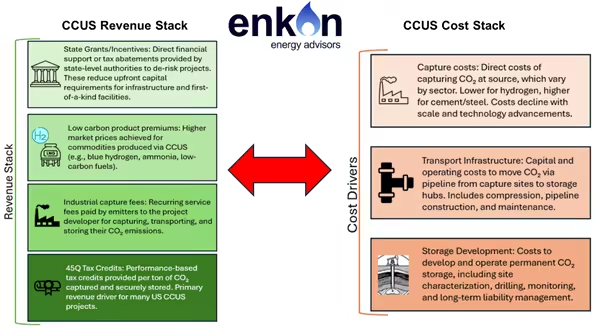
At the center of nearly every U.S. CCUS project is the federal 45Q tax credit. The credit provides a fixed payment per ton of CO₂ captured and stored for 12 years, creating a predictable revenue stream that resembles a contracted infrastructure payment. Crucially, recent reforms made these credits transferable, unlocking a growing market of tax equity investors and enabling developers to monetize credits more easily. This change significantly improved financing prospects by converting policy support into something closer to a bankable cash flow.
A second major revenue source comes from industrial emitters themselves. Refineries, petrochemical plants, hydrogen facilities, and other heavy industries increasingly view carbon management as a service they are willing to pay for. Long-term take-or-pay contracts are beginning to appear in CCUS. These agreements provide predictable capture fees per ton of CO₂ handled, strengthening project revenue certainty.
CCUS also enables the production of lower-carbon fuels and commodities such as blue hydrogen, ammonia, and low-carbon LNG. These products can command price premiums or access new markets, creating an additional revenue layer that improves overall project economics.
Federal and state grant programs further reduce upfront capital costs, improving early project returns and helping first-of-a-kind projects reach financial close.
The Cost Drivers
While the revenue side has strengthened, the cost side remains complex and highly dependent on industry and location. Capture is often the most visible cost, but not the only one. Costs vary widely by sector: capturing CO₂ from hydrogen production or natural gas processing is relatively inexpensive, while cement, steel, and power generation remain more challenging and costly.
Transport infrastructure is the next major component. CO₂ pipelines, compression facilities, and shared transport networks require significant upfront capital. However, as infrastructure expands and multiple emitters connect to shared systems, costs per ton decline significantly.
Finally, storage development adds another layer of investment. Characterizing geological formations, drilling injection wells, and monitoring stored CO₂ over time all contribute to project costs. Over time, shared storage hubs are expected to reduce these costs through economies of scale.
The Gulf Coast Carbon Hubs
One of the most important developments in CCUS is the rise of regional carbon hubs, particularly along the U.S. Gulf Coast. These hubs aggregate emissions from multiple industrial facilities and connect them to shared CO₂ pipelines and storage sites. The result is a model that mirrors the evolution of natural gas and LNG infrastructure: shared systems, multiple customers, and economies of scale. By spreading costs across many emitters and creating repeatable project structures, hubs significantly improve financing prospects. They transform CCUS from isolated projects into networked infrastructure.
Despite strong progress, investors are rightly concerned about some key risks that remain. For example, stored CO₂ must remain underground for decades, raising questions of long-term liability. Policy frameworks, including the 45Q tax credit, must remain stable to ensure cash flow, and emitter creditworthiness is essential for maintaining revenue certainty. However, when projects are structured as hubs with multiple customers and diversified revenue streams, investors should be increasingly comfortable with these risks.
Conclusion
The bottom line is that CCUS projects are becoming increasingly commercially viable in certain sectors including hydrogen production, natural gas processing, ammonia plants, etc. Other sectors, including cement, steel, and power, will require further cost reductions and market development before attracting comparable financing. These industries incur higher capture costs due to the emitted CO2 being diluted and mixed with flue gas. Capturing it requires large equipment, more energy, and higher operating costs.
But the foundation is being built. As more carbon hubs move forward and financing structures mature, the industry will shift from proving the concept to scaling it.
-Siddhant Kulkarni
If you are interested in diving deeper into CCUS strategy and market developments, please contact us at info@enkonenergy.com. We encourage you to subscribe to our articles to get weekly articles via email.
Enkon Energy Advisors is a boutique consulting firm specializing in oil & gas, and energy transition since 2012. We bring deep expertise in a range of markets including natural gas, NGLs, Oil, LNG, and Energy Transition where we provide commercial and market advisory to investors, energy companies, and project developers with consulting services, subscription reports, and analytics, with the goal of delivering commercially actionable outcomes to our client.