
The first quarter of 2026 has reinforced something the market already knows but rarely states plainly: more supply does not mean easier access. Recent disruptions in the Middle East have kept pressure on LNG availability even as production continues to grow.
In Australia, cyclone-related outages temporarily disrupted LNG exports, tightening supply into Asia during peak seasonal demand. At the same time, escalating geopolitical tensions involving Iran have raised concerns over potential disruptions to Middle East flows, which account for roughly 20% of global LNG supply via the Strait of Hormuz (with 17% of Qatar LNG rendered inoperable due to the conflict). Even short-lived disruptions have had outsized effects, reflecting how little uncommitted supply exists to absorb shocks. Both examples point to the same underlying issue: when something goes wrong, there is limited buffer. Supply is at historically elevated levels, yet the market remains tight. The issue is not production. It is who has the right to that gas, and under what terms.
Flexible/ Short-Term LNG
Most LNG is sold under long-term contracts, which limits how much is freely available at any given time. New export capacity continues to come online, but the majority of it is already contracted before first cargo. In 2024, only around one-third of global LNG trade moved on a spot or short-term basis. The rest was secured under long-term agreements, leaving a relatively thin slice of supply available to buyers without existing contracts.
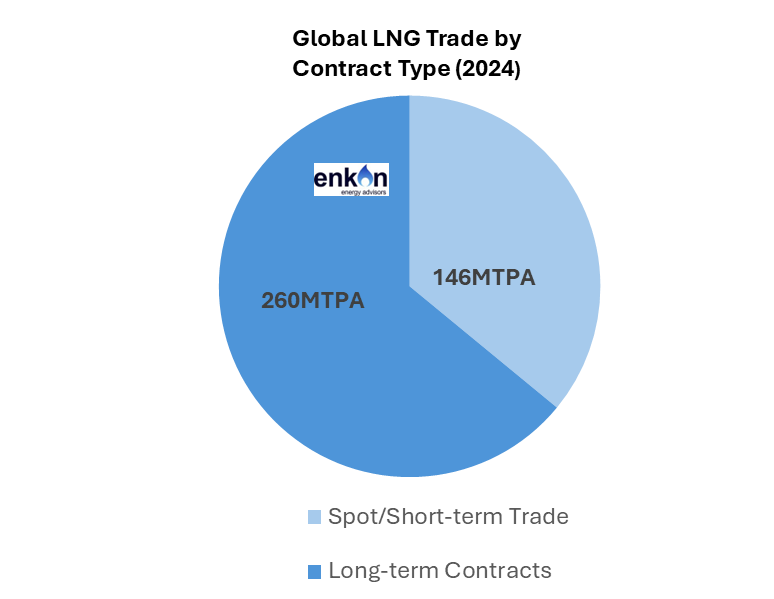
Global LNG trade reached about 406 MT in 2024, according to GIIGNL, reflecting continued growth in supply. But record volumes have not eased market tightness. The system remains sensitive to disruption, and the reasons are structural. Portfolio players provide flexibility by redirecting cargoes, optimizing delivery timing, and smoothing short-term imbalances. But that flexibility has limits. When Europe and Asia face peak demand at the same time, as they often do, reallocation becomes a zero-sum exercise. Moving supply from one region relieves pressure there and creates it elsewhere. The pool of available supply is narrow enough that even modest shocks can ripple quickly through the market.
Where Flexibility Is Increasing
Looking ahead, the composition of future supply tells an important story about how much flexibility may enter the market. Based on executed offtake agreements from U.S. LNG projects, roughly half of future contracted capacity is tied to global portfolios players.
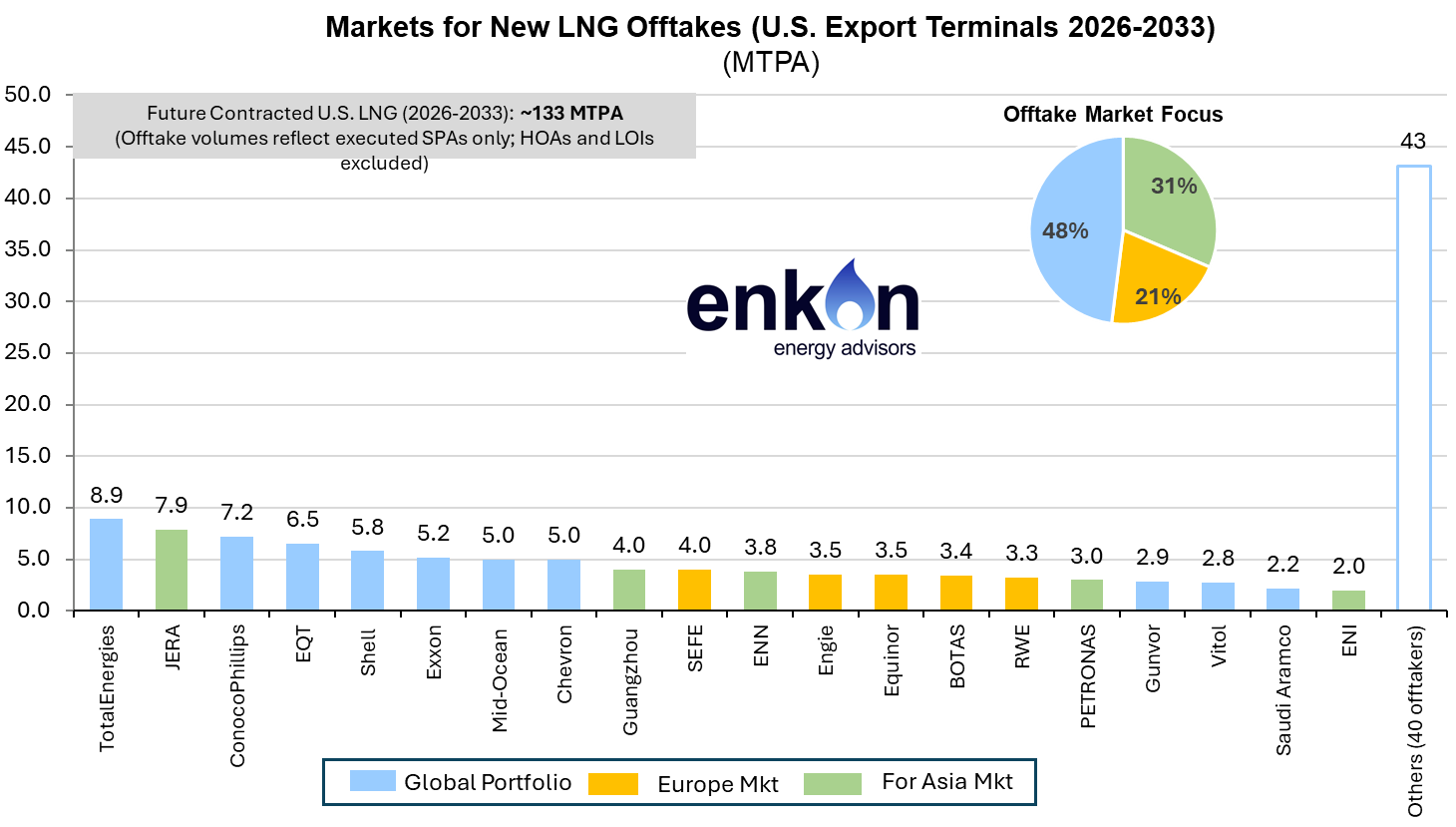
Portfolio players have the ability to redirect cargoes across regions, optimize delivery timing, and respond to short-term imbalances. A larger share of supply in their hands increases potential market liquidity. This does not mean a fully liquid spot market. But it does point to a gradual increase in effective liquidity, as more volumes sit within portfolios that can respond dynamically to market conditions.
The nature of U.S. LNG contracts reinforces this shift. Many U.S. volumes are linked to Henry Hub and sold on a free-on-board basis, making them destination-flexible. This contrasts with more rigid, destination-bound structures seen in some legacy contracts. As a result, U.S. LNG plays an increasingly key role in enabling portfolio optimization and cross-basin balancing.
Conclusion: The Market Is Evolving
The central question in LNG is shifting- It is no longer just how much LNG is being produced. It is who has access to it, on what terms, and whether it can reach the right market at the right time.
Demand-side pressure adds to the complexity. European buyers continue to secure long-term supply following the loss of Russian gas. Asian demand, from established importers such as Japan and Korea to faster-growing markets across Southeast Asia, remains robust. U.S. export policy continues to evolve, adding further uncertainty to an already tight contracting environment. In this environment, tracking supply growth is necessary but not sufficient. What matters is understanding who controls access, what contracts govern it, where flexibility exists, and where it does not.
In today’s LNG market, supply is no longer the constraint. Access is.
– Rhoda Kolapo
If you are interested in our global LNG analysis, please contact us at info@enkonenergy.com. We encourage you to subscribe to our articles to get weekly articles via email.
Enkon Energy Advisors is a boutique consulting firm specializing in oil & gas, and energy transition since 2012. We bring deep expertise in a range of markets including natural gas, NGLs, Oil, LNG, and Energy Transition where we provide commercial and market advisory to investors, energy companies, and project developers with consulting services, subscription reports, and analytics, with the goal of delivering commercially actionable outcomes to our client.