
Donald Trump returning to office in 2025 caused much of the climate policy world to brace for major disruption. Federal decarbonization, offshore wind leasing, and electric vehicle mandates all appeared to become vulnerable. Yet one climate technology has continued to advance with comparatively less turbulence: Carbon Capture, Utilization and Storage (CCUS).
Trump has long criticized aggressive climate regulation and withdrawn the U.S. from international climate commitments in his first term as president. But carbon capture occupies a unique political space. It aligns with fossil fuel production and bipartisan tax policy, making it a rare climate technology that would remain resilient under a Republican administration.
A Bipartisan Foundation
The backbone of carbon capture economics in the U.S. is the federal 45Q tax credit. It is a performance-based tax incentive for capturing and storing carbon dioxide. While originally created in 2008, it was substantially expanded in 2018 during Trump’s first term. The expansion saw an increase in the per-ton credit for permanently stored CO2 and extended eligibility timelines. This transformed CCUS from a niche pilot concept into a feasible pathway to decarbonization.
In 2022, the Inflation Reduction Act further enhanced 45Q, increasing credit values once again. The result is a rare policy arc, having undergone expansions under both Republican and Democratic administrations.
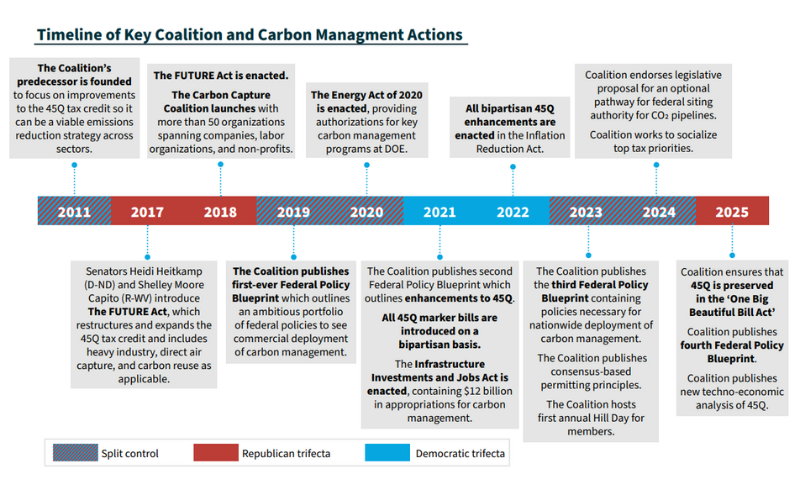
Source: Carbon Capture Coalition
Carbon capture incentives were also built through cross-party negotiations, particularly from lawmakers representing oil and gas states such as Texas, Louisiana, and North Dakota. Hence, in practical terms, repealing or weakening 45Q would mean disrupting billions in planned industrial development across very influential regions.
Energy Dominance meets Decarbonization
Trump’s energy philosophy centers on “energy dominance”, with his intent being to maximize domestic oil and gas production, expand LNG exports, and strengthen industrial capacity. Carbon capture does not conflict with this vision but in fact, complements it. Unlike wind and solar power, CCUS extends the economic life of existing infrastructure. Natural gas plants can continue operating with capture systems while refineries and petrochemical facilities can reduce emissions without shutting down.
That distinction is important as traditionally, technologies perceived as replacing coal, oil, or gas often trigger resistance in fossil-heavy sectors. CCUS, in contrast, protects these sectors while drastically improving their emissions profile. For policymakers prioritizing jobs and industrial stability, that is a very compelling value proposition.
Industrial Decarbonization and Global Competition
Carbon capture’s strategic relevance extends beyond domestic politics. Heavy industrial sectors like cement, steel, hydrogen, refining face limited decarbonization options. Electrification alone cannot eliminate process emissions in cement production. Hydrogen manufacturing from natural gas requires capture to meaningfully reduce lifecycle emissions.
Europe has moved aggressively on industrial carbon capture infrastructure, linking emitters to offshore storage hubs in the North Sea. China continues investing in lower-carbon industrial production. So, for the U.S., maintaining competitiveness in hard-to-abate sectors increasingly intersects with CCUS deployment. Supporting carbon capture can therefore be framed not as climate activism but as economic realism. It preserves export capacity, protects jobs, and ensures that U.S. producers are not disadvantaged in carbon-conscious global markets.
The Next Wave of CCUS
We are discussing carbon capture’s political durability because deployment is accelerating. The next phase of U.S. CCUS projects is no longer about isolated facilities but is more about a regional infrastructure buildout.
Along the Gulf Coast, large scale CO2 transport and storage hubs are advancing, supported by energy titans like ExxonMobil and Occidental Petroleum. These hubs aim to aggregate emissions from refineries, petrochemical plants, hydrogen facilities, etc. to create economies of scale that lower capture costs per ton.
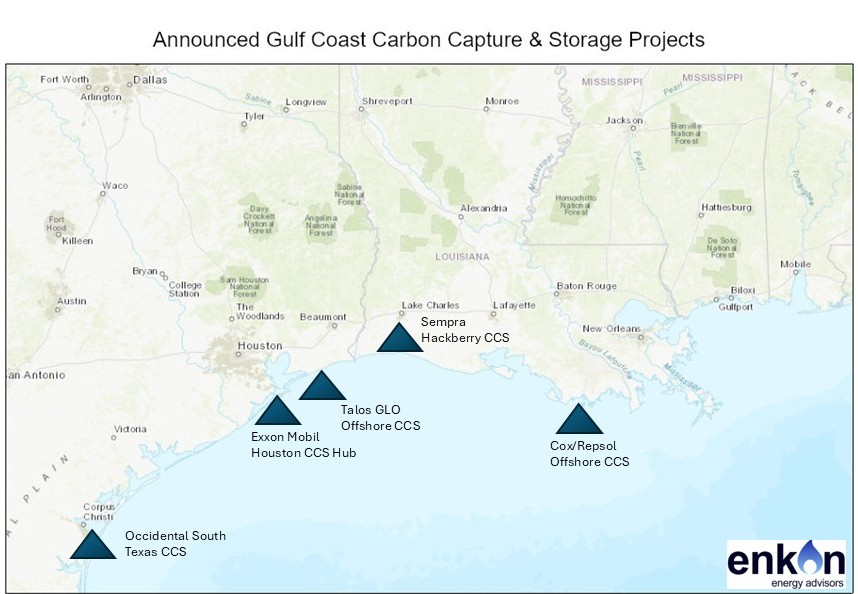
If the 45Q framework remains stable as we suspect it to be, 2026-2029 could mark the transition from project announcements to actual construction and operation. The political resilience of CCUS today directly shapes whether that infrastructure materializes.
Carbon capture may be politically safe under Trump. But political safety does not guarantee commercial success. The next question is more consequential, are these projects actually bankable? In our next post centered on CCUS, we’ll break down the economics of a modern CCUS project, from 45Q revenue stacking to storage risk, and examine whether the numbers truly work.
-Siddhant Kulkarni
If you are interested in diving deeper into CCUS strategy and market developments, please contact us at info@enkonenergy.com. We encourage you to subscribe to our articles to get weekly articles via email.
Enkon Energy Advisors is a boutique consulting firm specializing in oil & gas, and energy transition since 2012. We bring deep expertise in a range of markets including natural gas, NGLs, Oil, LNG, and Energy Transition where we provide commercial and market advisory to investors, energy companies, and project developers with consulting services, subscription reports, and analytics, with the goal of delivering commercially actionable outcomes to our client.