
Most conversations about LNG demand focus on long term growth and seasonal patterns. But there is another dimension that is easy to overlook and increasingly hard to ignore: the diurnal nature of LNG feed gas fluctuations.
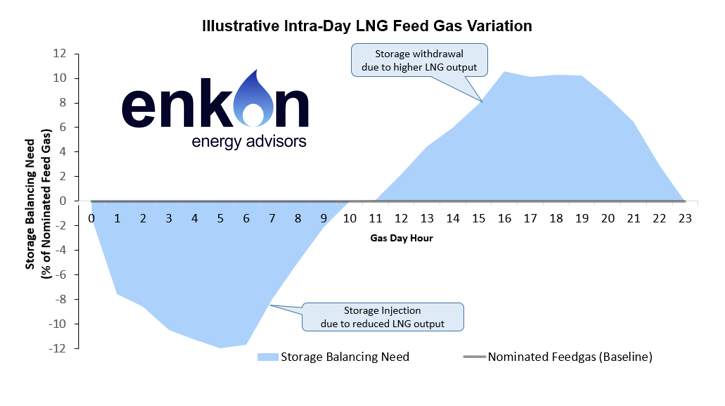
Picture a large LNG export facility along the U.S. Gulf Coast. In the early morning hours, its compressors ramp up and feedgas intake rises to maintain liquefaction output. Later in the day, ambient temperature driven operational adjustments shift fed gas requirements, causing gas demand to ease before climbing again as operations stabilize. These swings are not anomalies. They are a routine feature of how liquefaction plants operate and how they get derated depending on the ambient temperatures, particularly during the summer season.
For the pipelines delivering gas to these LNG export facilities, even modest changes in feed gas intake can produce measurable shifts in flow. As LNG export capacity continues to expand along the Gulf Coast, these intraday patterns are becoming an increasingly crucial factor in how pipelines and storage operators manage the broader gas system.
What Drives Intraday LNG Demand?
Diurnal demand refers to consumption patterns that vary within a 24-hour period. For LNG export facilities, this variability is largely a product of how liquefaction plants operate. Liquefaction relies on large compressors and gas turbines to chill natural gas to around -260°F, converting it to liquid form. These processes are energy intensive and require substantial volumes of feedgas to maintain steady output. Operational adjustments, including changes in train utilization, scheduled maintenance, or shifts in power consumption, can cause feedgas requirements to rise and fall throughout the day. The result is a demand profile that does not remain constant and can introduce noticeable variability in regional pipeline flows.
Unlike traditional industrial or residential consumers whose usage tends to remain relatively predictable within a day, LNG terminals can introduce sharper swings in regional gas demand.
Ripple Effects on Pipelines and Balancing
Along the U.S. Gulf Coast, where LNG terminals now account for a substantial share of regional gas consumption, intraday feedgas variability translates directly into fluctuations in pipeline flows. Pipeline operators must respond by adjusting nominations, managing linepack, and coordinating with terminal operators in near real time. As LNG capacity continues to grow, this coordination challenge intensifies. What was once a manageable operational consideration is becoming a structural feature of how Gulf Coast pipelines operate on a day-to-day basis. Infrastructure planning and operational protocols designed around more stable demand profiles will increasingly need to adapt and rely on increasing flexibility in the system – enter “Firm Hourly Balancing Service” being offered by gas storage projects in the U.S. Gulf Coast.
Why Storage Infrastructure Matters More Than Ever
Natural gas storage has traditionally been a tool for seasonal balancing, injecting gas during lower demand summer months and withdrawing it during winter. But the diurnal nature of LNG feedgas demand is expanding the role that storage needs to play. High deliverability storage, particularly salt cavern facilities along the Gulf Coast, is well suited to absorbing intraday variability. Unlike depleted reservoir storage, which is designed for slower seasonal cycling, salt caverns can inject and withdraw gas quickly and repeatedly. This makes them particularly effective at responding to the short duration swings that LNG terminals introduce. As LNG exports grow, storage operators with high deliverability assets near export corridors are increasingly well positioned to provide the flexibility services the market needs, not just across seasons but across the hours of a single day.
Looking Ahead
The United States is on track to remain the world’s largest LNG exporter, with additional liquefaction capacity under construction or in development across the Gulf Coast. As that capacity comes online, the intraday characteristics of LNG feedgas demand will become an even more prominent feature of the gas market landscape.
For pipelines, storage operators, and market participants, understanding and planning for this diurnal dimension will be just as important as tracking the seasonal and long-term demand trends that dominate most industry conversations.
How is your organization thinking about intraday demand variability as LNG exports continue to grow?
– Rhoda Kolapo
If you are interested in diving deeper into LNG, natural gas and midstream market developments, please contact us at info@enkonenergy.com. We encourage you to subscribe to our articles to get weekly articles via email.
Enkon Energy Advisors is a boutique consulting firm specializing in oil & gas, and energy transition since 2012. We bring deep expertise in a range of markets including natural gas, NGLs, Oil, LNG, and Energy Transition where we provide commercial and market advisory to investors, energy companies, and project developers with consulting services, subscription reports, and analytics, with the goal of delivering commercially actionable outcomes to our client.