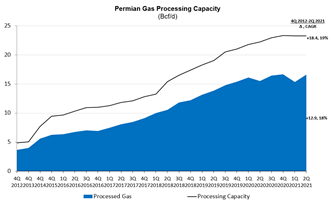
The Permian basin has gone through a prolific growth period since the shale boom began last decade. Permian basin natural gas production has almost grown 400% from late 2012 to mid-2021, surging from 4.5 Bcf/d in 4Q12 to 18 Bcf/d in 2Q21. During that time, new entrants (in the upstream and midstream segments) tried to capture the production boom and build the infrastructure needed to get fuel to downstream oil, gas and NGL markets. The massive build out of infrastructure has recently leveled out, however. For example, gas processing capacity in the Permian basin remains under-utilized on an aggregate basis with little to no growth in gas processing capacity since 1Q 2020.
With growth prospects limited, we see significant consolidation ahead in both the upstream and midstream segments. In the last few years, there have been numerous mergers and acquisitions of entities in the Permian Basin as the parties try to strengthen their financial positions through scale and more targeted strategic acquisitions. Since 2020, here are some of the mergers and acquisitions occurring in the Permian basin.
| Date | Sector | Buyer | Seller |
| 1Q 2021 | Producer | Pioneer Resources | Parsley Energy & Doublepoint Energy |
| 1Q 2021 | Producer | Conoco Phillips | Concho |
| March 2021 | Producer | Chevron | Noble Resources |
| 3Q 2021 | Producer | Cabot (New entity Coterra Energy) | Cimarex Energy |
| 3Q 2021 | Producer | Callon Petroleum | Primexx Energy |
| 2Q 2021 | Producer | Vencer Energy | Hunt Oil |
| 4Q 2020 | Midstream | Stakeholder Midstream | Santa Fe Midstream |
| 1Q 2022 | Midstream | Crestwood | Oasis Midstream |
| 1Q 2022 | Midstream | Altus Midstream | Eagle Claw Midstream |
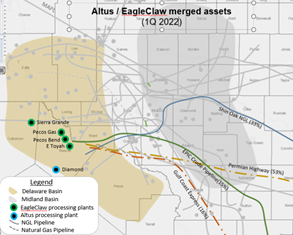
Why are they merging? What are their benefits? Let’s take a deeper look at the most recent combination of Altus Midstream and Eagle Claw Midstream. Altus Midstream merged with BCP Raptor, the holding company of Eagle Claw Midstream. Combined, they would be the largest integrated midstream operator in the Delaware portion of the Permian basin. They would have earnings from multiple sectors of the value chain, strengthening their ability to generate more reliable revenue streams. Their combined assets include 850,000 acres under fee-based, long-term dedications for midstream activities, a combined gathering footprint, 2 Bcf/d of cryogenic natural gas processing facilities, and interests in four newly constructed pipelines from the Permian to the gulf coast – namely, the Permian Highway natural gas pipeline (27% from Altus, 26.7% from EagleClaw), the Gulf Coast Express natural gas pipeline (16% from Altus), the Shin Oak NGL pipeline (33% from Altus), and EPIC crude pipeline (15% from Altus). A map of their combined facilities highlights their key role in the Delaware.
This new entity may benefit from combined complementary vertical systems, an expanded footprint in the Delaware basin, a more diverse customer base, and enhanced reliability and flexibility for their customers. Economies of scale could reduce their operating, general and administrative costs, increase efficiencies, and make their company more competitive. Combined capital needs, meanwhile, could result in high free cash flow conversion from capital savings.
Permian operators continue to follow the logic of consolidation. What will help this combined entity (and other midstream players) is an uptick in crude and gas production – which is already happening with the private E&P players. It remains to be seen how long the publicly traded companies sit on the fence in these very favorable commodity cycle…only time will tell.