
Introduction
Liquefied Natural Gas has moved from being a convenient supplement to the global gas trade to being the system’s shock absorber. Nothing has made that clearer than the past six months. A regional conflict in the Persian Gulf removed a meaningful share of the world’s most reliable LNG supply almost overnight, and it was U.S. cargoes—flexible, destination-free, and abundant—that filled the gap. The U.S. now occupies the position it has been building toward for a decade: supplier of last resort, and increasingly, supplier of first choice. The harder question is how long that window stays open.
A Supply Shock and a Swing Supplier
The 2026 Persian Gulf conflict has reshaped the near-term LNG balance. Iranian strikes on Ras Laffan and Mesaieed in March damaged two of Qatar’s fourteen liquefaction trains and one of its two gas-to-liquids facilities, prompting QatarEnergy to declare force majeure on a portion of its contracts. Roughly 12.8 MTPA of production is expected to be sidelined for three to five years, cutting close to 17% of Qatari LNG export capacity and displacing an estimated $20 billion in annual revenue. Qatar has since slipped down the global export rankings.
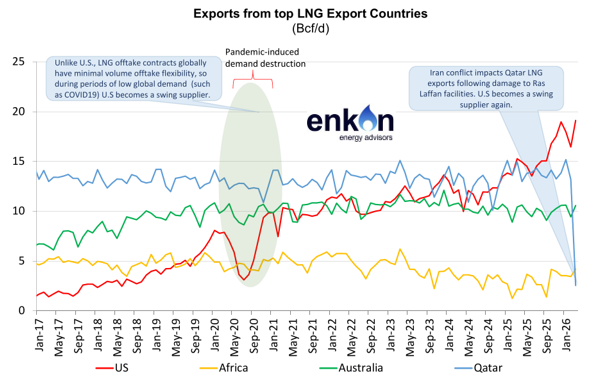
Unlike most global offtake contracts, which carry minimal volume flexibility, U.S. contracts let buyers lift, divert, or cancel cargoes as economics dictate. That flexibility is precisely why the U.S. has become the market’s swing supplier—first during the COVID demand collapse, when American cargoes were curtailed, and now in the opposite direction. U.S. exports averaged ~18.2 Bcf/d in 2Q 2026 (~18.6 Bcf/d year-to-date), with capacity utilization hitting 96% against a post-COVID average near 88%. Europe remains the primary destination, absorbing roughly 60% of U.S. exports, and its need is acute. EU storage entered June at just 38% of capacity after a cold tail to the 2025/26 winter, and sat near 51% in early July—well below the five-year norm, with Germany at roughly 41%. Brussels has already relaxed the November 1 fill target from 90% to 80%; meeting even that requires LNG imports to run ~13% above 2025 levels. TTF closed above €55/MWh in mid-July, its highest since March.
The Capacity Build-Out Behind the Response
The U.S. can play this role only because of the infrastructure wave now moving from paper to steel. Commercial activity stayed strong in 2Q 2026, with ~8 MTPA of firm SPAs and ~3 MTPA of non-binding HOAs and LOIs across North American projects. Two developments reached Final Investment Decision:
- Commonwealth LNG (9.5 MTPA, six trains) — FID in May 2026, with ~85% of capacity contracted and financing commitments from 20 lenders
- Delfin FLNG 1 (4.4 MTPA) — FID in June 2026, the first U.S. floating liquefaction project and the largest FLNG unit sanctioned globally, backed by a $5 billion investment including $300 MM from MOL
Golden Pass Train 1 and ECA LNG Phase 1 both achieved first LNG in the quarter, while Corpus Christi Stage 3 Train 6 continued commissioning. Midstream is keeping pace: White Water’s 2.5 Bcf/d Pelican Lateral will serve Commonwealth, and Port Arthur LNG’s 2.0 Bcf/d Louisiana Connector entered service. Ksi Lisims LNG also signed LOIs and HoAs with SEFE and Uniper—Canada’s first LNG agreements with European buyers.
Not every project clears the bar. Saguaro LNG remains the cautionary case: fully contracted on paper, but stalled by permitting errors, leadership turnover, financing turmoil, and rising costs. Contracted capacity is necessary but not sufficient. Among pre-FID developments, Texas LNG currently screens as the only Tier 1 project on Enkon’s terminal scorecard.
Taken together, U.S.-sourced nameplate capacity is forecast to reach ~34.3 Bcf/d by 2033/34 across 17 terminals, up from 15.3 Bcf/d at year-end 2025.
The Domestic Squeeze: Exports Meet the AI Load
LNG feed gas demand is projected to climb from ~16 Bcf/d in 2025 to ~38.5 Bcf/d by 2034—but LNG is no longer the only source of incremental pull on U.S. gas. Total Lower 48 requirements are forecast to grow ~32 Bcf/d through 2034, with the power sector adding 6–7 Bcf/d—much of it data center and AI load—plus ~3.2 Bcf/d of industrial growth from nearshoring and ~9 Bcf/d of pipeline exports to Mexico.
This is the first cycle in which LNG exporters and domestic power buyers compete for the same marginal molecule. Supply should answer: U.S. dry gas production is forecast to reach 131 Bcf/d by 2035, led by the Permian, Haynesville, and Appalachia, with Henry Hub averaging ~$4.5/MMBtu over 2026–2035, held within a $3–5 range by short-cycle shale. That elasticity is the quiet foundation of the entire U.S. LNG thesis—it keeps American cargoes competitive against Brent-indexed supply. Netbacks remain compelling in the meantime: against forward strips, the average spread to Henry Hub sits near $8.4/MMBtu from both Asia and Europe.
Conclusion
Today’s environment is exceptionally favorable for U.S. LNG, but it is worth being clear-eyed about why. Much of the current tightness stems from a disruption that is, by design, temporary: Enkon’s base case assumes Middle East production recovers in 2027 and Qatar’s damaged capacity is rebuilt by 2030. Beyond that, the market looks materially different. With ~255 MTPA under construction globally and liquefaction capacity heading toward 855 MTPA by 2035, the 2029–2032 window carries genuine oversupply risk, with TTF settling into $10–13/MMBtu and JKM into $12–14/MMBtu.
The projects that thrive through that cycle will be the ones locking in firm, long-dated offtake now, at today’s pricing power, and reaching FID with financing and permitting in order. Crisis-driven demand is real revenue, but it is not a strategy. The structural case—~4% annual demand growth through 2045, roughly 80% of it from emerging Asia—is what should anchor investment decisions. The window is open, but not indefinitely: the winners will be decided by what gets sanctioned in the next 24 months.
If you are interested in the U.S. and Global LNG outlook and obtaining a detailed analysis on the implications of the current market environment, please contact us at info@enkonenergy.com. We encourage you to subscribe to our articles to get weekly articles via email.
Enkon Energy Advisors is a boutique consulting firm specializing in oil & gas, and energy transition since 2012. We bring deep expertise in a range of markets including natural gas, NGLs, Oil, LNG, and Energy Transition where we provide commercial and market advisory to investors, energy companies, and project developers with consulting services, subscription reports, and analytics, with the goal of delivering commercially actionable outcomes to our client