
For most of the AI buildout, the bull case rested on stated intentions — capex guidance, memoranda of understanding, and press releases. That era ended in the second quarter of 2026. What sits on turbine supplier books today is contracted, priced, and in a growing share of cases prepaid, with delivery slots reserved into the next decade. And then, on August 3, Texas governor, the state with more data center projects in development froze new grid connections pending an audit. Two signals, opposite directions, both real. The question for anyone underwriting this buildout is which one is binding?
The Order Book: From Forecast to Firm Contract
The second-quarter prints across the power and infrastructure complex were not incremental. GE Vernova closed the quarter with a total backlog of ~$176 billion after organic orders rose 88% year-over-year to $24.2 billion, adding ~$13 billion sequentially. Its electrification equipment backlog reached ~$41 billion, up 69%, with data center orders in that segment exceeding $5 billion in the first half — more than double the full-year 2025 total. On the generation side, 20 GW of gas equipment was contracted in a single quarter, lifting the gas backlog to 53 GW against a target of at least 125 GW under contract by year-end.
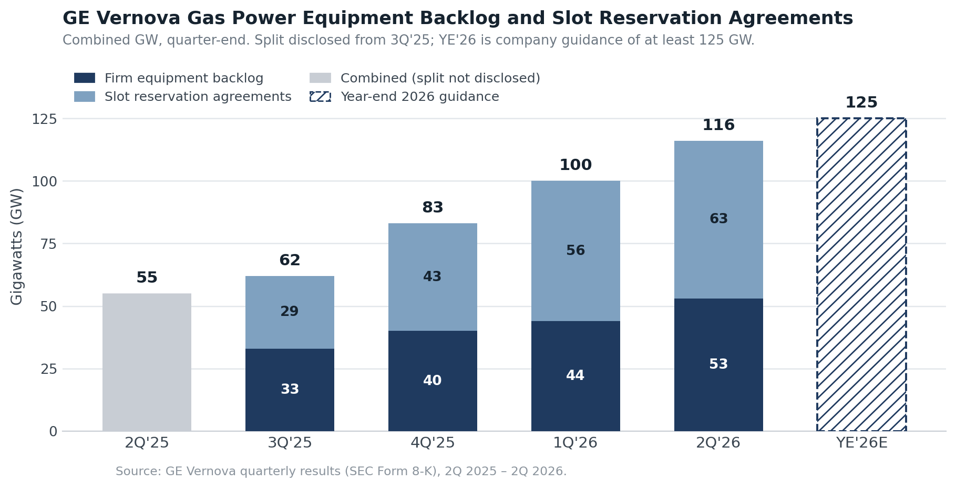
The composition of that turbine book matters as much as its size. Of the 116 GW contracted at quarter-end, 53 GW represents firm equipment backlog, and 63 GW sits in slot reservation agreements — commitments to a manufacturing position that can be deferred or cancelled if demand forecasts soften or financing tightens. Firm orders have compounded steadily, from 33 GW in 3Q’25 to 53 GW, and management expects them to overtake reservations during the second half of 2026 as customers secure EPC capacity and convert. Until that crossover occurs, the headline figure overstates committed capacity, and the distinction is the single most useful lens for reading the sector’s backlog disclosures.
Eaton reported total Electrical sector backlog up 43% year-over-year. Electrical Americas backlog reached ~$15.2 billion, up 33%, on a rolling twelve-month book-to-bill of 1.3; Electrical Global backlog more than doubled, up 103%, as thermal and power-management demand compounded on top of the core electrical book. The pattern extends downstream. Digital Realty ended the quarter with a record $1.9 billion backlog of signed-but-not-commenced leases at 100% share, its own share up 75% since January and now equal to ~30% of data center rent. Its development pipeline stands at 1.4 GW under construction at ~$20 billion of cost, 63% pre-leased, with cash re-leasing spreads at a record 25.4% and greater-than-1-MW mark-to-market near 67%.
Backlog Has Become the Scarce Asset
In a conventional capital goods cycle, backlog is a residue of sales. In this one it is the product. When lead times for turbines, transformers, switchgear, and high-density cooling run years rather than quarters, the constrained commodity is the delivery slot itself — and the economics reorganize around that scarcity in three observable ways.
Pricing power sits with the supplier. GE Vernova reported first-half of 2026 equipment orders pricing more than 20% above 4Q 2025 levels as reserved slots converted into firm backlog at current terms. Customers now fund the queue. Higher down payments and prepayments have become standard, which is why free cash flow across these names is growing faster than earnings — GE Vernova generated $5.1 billion of free cash flow in the quarter; Vertiv $925 million, up 234% year-over-year.
Visibility extends past the cycle. GE Vernova’s backlog now runs into 2031; Digital Realty already schedules $480 million of rent commencement in 2027 and $312 million in 2028 and beyond. Contracted capacity is necessary but not sufficient — the same caveat that applies to sanctioned liquefaction applies here. Conversion depends on a variable none of these companies control.
Texas Hits Pause: A Broader Reckoning
On August 3, 2026, Governor Greg Abbott directed the Public Utility Commission of Texas (PUCT) and ERCOT to pause grid connections for all new data centers pending a comprehensive audit. While the trigger was the sheer volume of interconnection requests — ERCOT is reviewing 474 GW of proposed new demand, 90% of which is from data centers — the audit is a symptom of a much deeper, statewide reckoning.
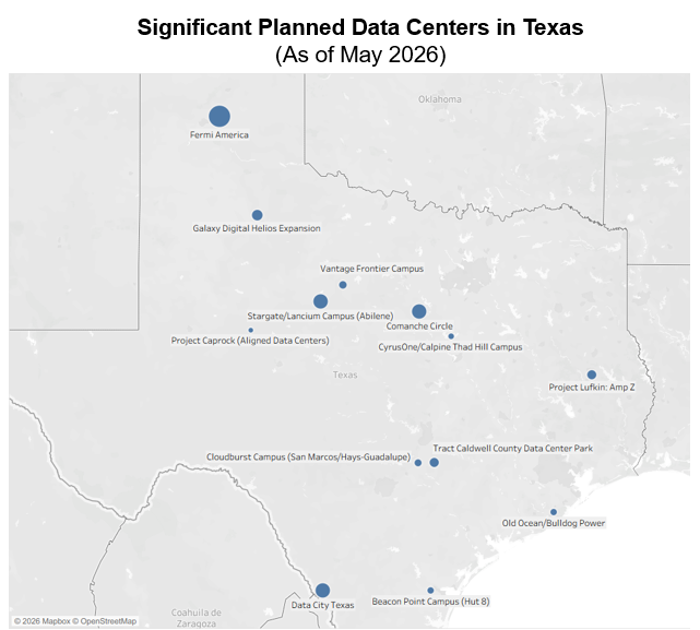
The scope of this pause extends far beyond substation queues; it targets the industry’s opacity, its drain on municipal resources, and a growing grassroots backlash.
Lawmakers and local governments have steadily escalated their resistance throughout 2026. In June, Governor Abbott directed the PUCT and ERCOT to mandate that data centers fully fund the electric infrastructure required to serve their operations—such as substations and transmission lines—rather than allocating those costs to residential ratepayers. At the local level, municipalities are increasingly intervening where the state previously held open doors. Hood County attempted countywide moratoriums early in the year, Hill County briefly enacted one, and in June 2026, San Marcos became the first Texas city to formally institute a moratorium on data center development amid intense community pushback.
ERCOT responded to the August 3 directive by immediately suspending its “Batch Zero” Large Load classification notifications and seeking a good cause exception at the PUCT’s August 20 meeting. Senate Bill 6, signed in 2025, already imposed disclosure and curtailment obligations on large loads of 75 MW and above, but this marks a severe escalation in enforcement.
One structural caveat matters. The directive governs ERCOT interconnection. Projects developing behind-the-meter generation (“BTM”) sit outside its immediate reach, which makes on-site power a strategic hedge. However, with the audit heavily scrutinizing water consumption and tax incentives, even off-grid solutions will face intensifying state and local scrutiny.
Conclusion
The Texas action should be read as a symptom rather than an anomaly. Lower 48 gas requirements are forecast to grow ~32 Bcf/d through 2034, with the power sector adding 6–7 Bcf/d, much of is attributed to data center and AI load, alongside LNG feed gas climbing from ~16 Bcf/d in 2025 toward ~38.5 Bcf/d by 2034. This is the first cycle in which liquefaction, industrial nearshoring, and hyperscale compute compete for the same marginal molecule, and the Gulf Coast is where those claims physically overlap.
Supply elasticity should ultimately answer the demand — short-cycle shale has repeatedly done so — but delivery infrastructure is a different constraint from resource. Transformers, turbines, and transmission clear on multi-year lead times that cannot be flexed the way a rig count can. Where capital used to be the binding constraint, permission and equipment now are.
-Kush Thakkar
If you are interested in the U.S. power and data center infrastructure outlook and obtaining a detailed analysis on the implications of the current market environment, please contact us at info@enkonenergy.com. We encourage you to subscribe to our articles to get weekly articles via email.
Enkon Energy Advisors is a boutique consulting firm specializing in oil & gas, and energy transition since 2012. We bring deep expertise in a range of markets including natural gas, NGLs, Oil, LNG, and Energy Transition where we provide commercial and market advisory to investors, energy companies, and project developers with consulting services, subscription reports, and analytics, with the goal of delivering commercially actionable outcomes to our client.