The outlook for global LNG changed materially in 2026. Prior to the escalation of conflict in the Middle East, the market was approaching a major wave of new liquefaction capacity, raising expectations of a looser global LNG balance toward the end of the decade. The disruption of LNG exports through the Strait of Hormuz and damage to Qatari liquefaction infrastructure, including strikes on the Ras Laffan industrial complex, challenged that outlook, removing significant supply from the market and delaying some of the capacity previously expected to come online.
The Capacity Buildout Is Still Coming
Despite the disruption, a substantial volume of new liquefaction capacity remains under construction globally, particularly in North America. Projects across the U.S., Canada and other producing regions are expected to add significant supply through the end of the decade, while disrupted Middle Eastern production could gradually return. The IEA’s Global LNG Capacity Tracker, updated in June 2026, estimates that roughly 345 bcm/yr (~254 MTPA) of new LNG export capacity is set to come online globally between 2025 and 2030 from projects that had already reached FID and were under construction as of 2025, marking the largest wave of capacity additions to date. While the Middle East conflict has materially reduced the near-term supply outlook, the scale of capacity already under development remains significant.
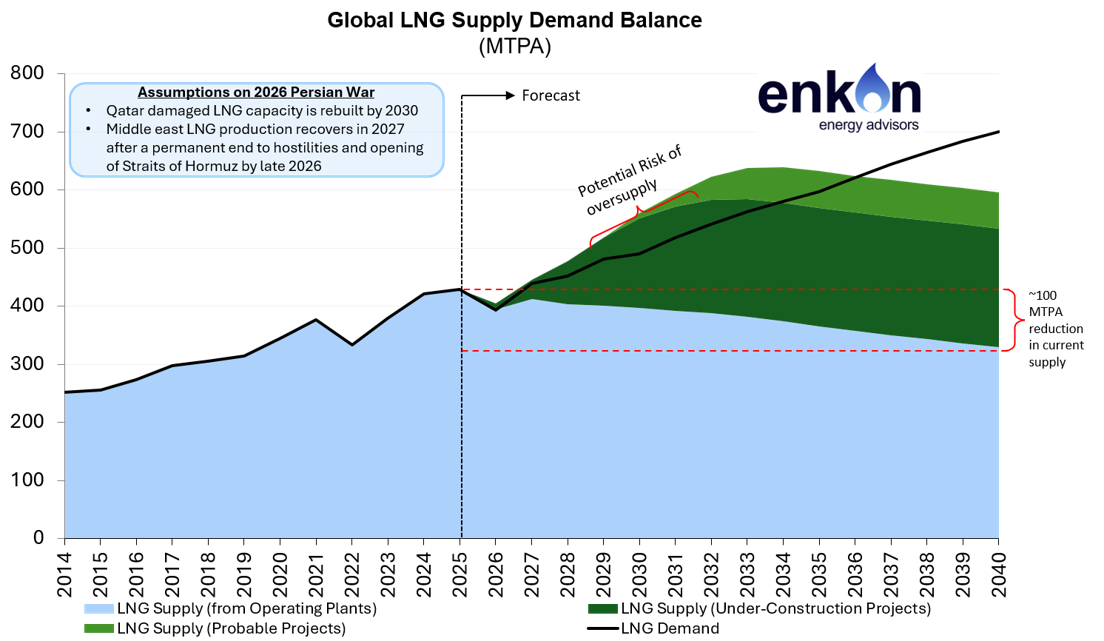
Our analysis indicates that the global LNG market could begin to loosen toward the end of the decade as a significant wave of new liquefaction capacity enters the market. As shown in the chart above, supply from projects currently under construction and probable developments could outpace expected demand, even as production from existing facilities gradually declines.
Potential Oversupply Is Primarily a Timing Issue
The potential surplus is primarily a question of timing. LNG projects have long development and construction cycles, meaning several large projects sanctioned in earlier years can enter service within a relatively narrow window. Demand, by contrast, tends to develop more gradually. This mismatch could create a temporary period in which supply exceeds demand. A potential surplus does not necessarily imply a prolonged LNG glut. Greater supply availability could put downward pressure on LNG prices and support additional demand, particularly in price-sensitive markets. Continued demand growth could also help narrow the imbalance over time.
Qatar’s Recovery Timeline Is the Wildcard
The events of 2026 have therefore changed the timing and magnitude of the expected LNG supply wave, but not necessarily its underlying direction. Near-term balances are tighter, and uncertainty around Qatar’s recovery and project schedules remains significant. The outlook remains sensitive to the pace of recovery in Middle Eastern LNG supply and the timing of new project start-ups. Nevertheless, substantial new capacity continues to progress toward the market while global LNG demand grows at a more measured pace.
The key question has therefore shifted from whether the LNG supply wave will arrive to when it will arrive and whether demand will have grown sufficiently to absorb it. Our current outlook suggests that a period of potential oversupply remains possible toward the end of the decade and into the early 2030s. Geopolitical disruption has delayed the potential surplus—not eliminated it.
– Rhoda Kolapo
If you are interested in the U.S. and global LNG outlook and a deeper analysis of the implications of the current market environment, please contact us at info@enkonenergy.com. We encourage you to subscribe to our articles to get weekly insights via email.
Enkon Energy Advisors is a boutique consulting firm specializing in oil & gas, and energy transition since 2012. We bring deep expertise in a range of markets including natural gas, NGLs, Oil, LNG, and Energy Transition where we provide commercial and market advisory to investors, energy companies, and project developers with consulting services, subscription reports, and analytics, with the goal of delivering commercially actionable outcomes to our clients.